- 15 000+ Verified Orders!
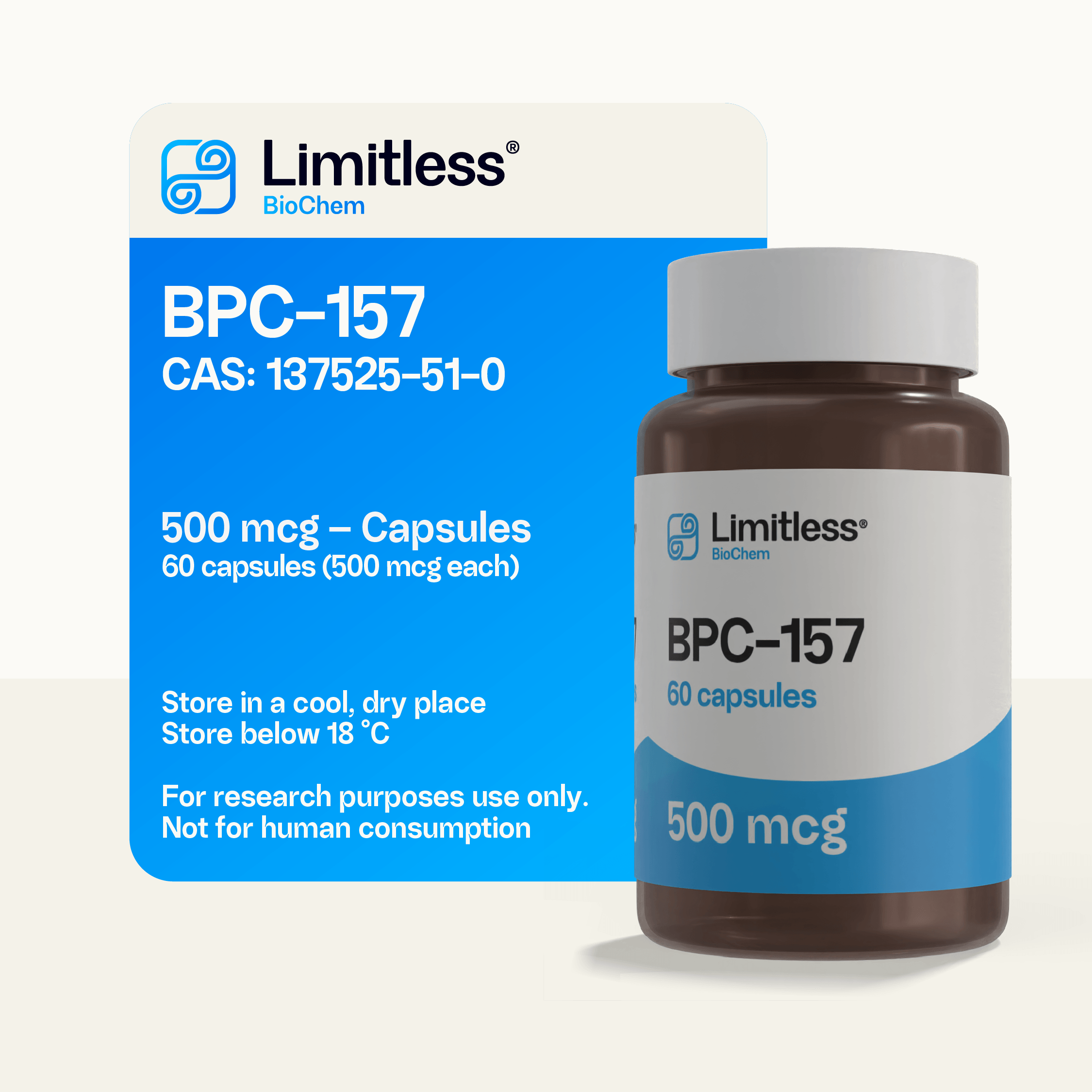
BPC-157 500 mcg – 60 capsules
64.20€
- Third Party Tested
- 14-Day Money Back Guarantee
- Fast Delivery Worldwide
Laboratory test for this product
View the certificate of analysis and laboratory verification for this product.
BPC-157 500 mcg — 60 research capsules. Body Protection Compound 157 is a synthetic 15-amino-acid peptide derived from a cytoprotective fragment of human gastric juice protein. It is among the most extensively studied tissue-repair peptides in modern preclinical research, with a published literature spanning more than 500 papers over three decades. The 500 mcg per-capsule dose mirrors the per-day intake used in the bulk of rodent oral studies, and the gastric origin of the parent molecule provides a biological rationale for stability through the GI tract — a feature documented across multiple oral-administration preclinical models.
Research Overview
BPC-157 is a partial sequence of a 40 kDa human gastric juice protein originally identified by Sikirić and colleagues in the early 1990s [1]. In contrast to most regenerative peptides, it shows oral bioavailability and remarkable stability in gastric acid — properties consistent with its physiological origin in the stomach. The peptide has been characterized in tendon, ligament, muscle, gut, vascular, neural and bone injury models, where it consistently accelerates structural recovery, restores barrier function and rescues vascular perfusion through a coordinated upregulation of growth factor receptors, the nitric oxide system and angiogenic signaling [1–3]. Recent mechanistic work has implicated formation of new vasculature (“salvage of the venous system”) as a unifying mechanism across organ systems [3]. With a benign safety profile through six-month rodent toxicology and a Phase II clinical evaluation in inflammatory bowel disease (PL 14736), BPC-157 stands as one of the few “research peptides” with a genuinely deep, reproducible evidence base.
Primary Research Areas
- Tendon, ligament and muscle injury repair: documented across transection, crush and detachment models with measurable improvements in load-to-failure, collagen organization and functional recovery scoring [1,2].
- Angiogenesis and vascular rescue: consistent enhancement of capillary density and “bypass” collateral formation in ischemia and venous-occlusion models, proposed as a unifying mechanism across organ systems [3].
- Gastrointestinal cytoprotection: characterized in NSAID-, ethanol-, stress- and colitis-induced injury models, with rapid restoration of mucosal integrity and barrier function [1].
- Neuroprotection and brain–gut axis: evaluated in TBI, encephalopathy and serotonergic/dopaminergic dysfunction models, with neurobehavioral and histological protection reported [2].
- Inflammation, NO signaling and wound healing: investigated for modulation of the L-arginine–NO axis, cytokine balance and skin/cornea wound closure kinetics [1,3].
References
- Sikirić P, Seiwerth S, Rucman R, et al. Brain–gut axis and pentadecapeptide BPC 157: theoretical and practical implications. Curr Neuropharmacol. 2016;14(8):857–865.
- Seiwerth S, Brcic L, Vuletic LB, et al. BPC 157 and blood vessels. Curr Pharm Des. 2014;20(7):1121–1125.
- Sikirić P, Skrtic A, Gojkovic S, et al. Stable gastric pentadecapeptide BPC 157 as a therapy for the disturbances of the venous system. Pharmaceuticals (Basel). 2020;13(4):71.
Find out what benefits peptides have
Discover how peptides can boost recovery, improve skin health, increase energy and support overall performance. Explained simply and clearly in this short video.
Why Limitless Biochem?
Limitless BioChem is a trusted supplier of research compounds. Our products meet strict quality standards and are compliant with EU requirements. We focus on the safe and reliable supply of peptides and pure compounds intended exclusively for research or collector purposes.
- Peptides, Nootropics, Amino acids...
- Products tested by an independent laboratory
- Exclusively pure compounds without additives
- Worldwide Delivery
- Warning
This product is not intended for human or veterinary use. It is for collection or research purposes only. It cannot be used as food, dietary supplement or medicine! The information provided in the text on this page is for educational purposes only and does not constitute medical or other advice.