- 15 000+ Verified Orders!
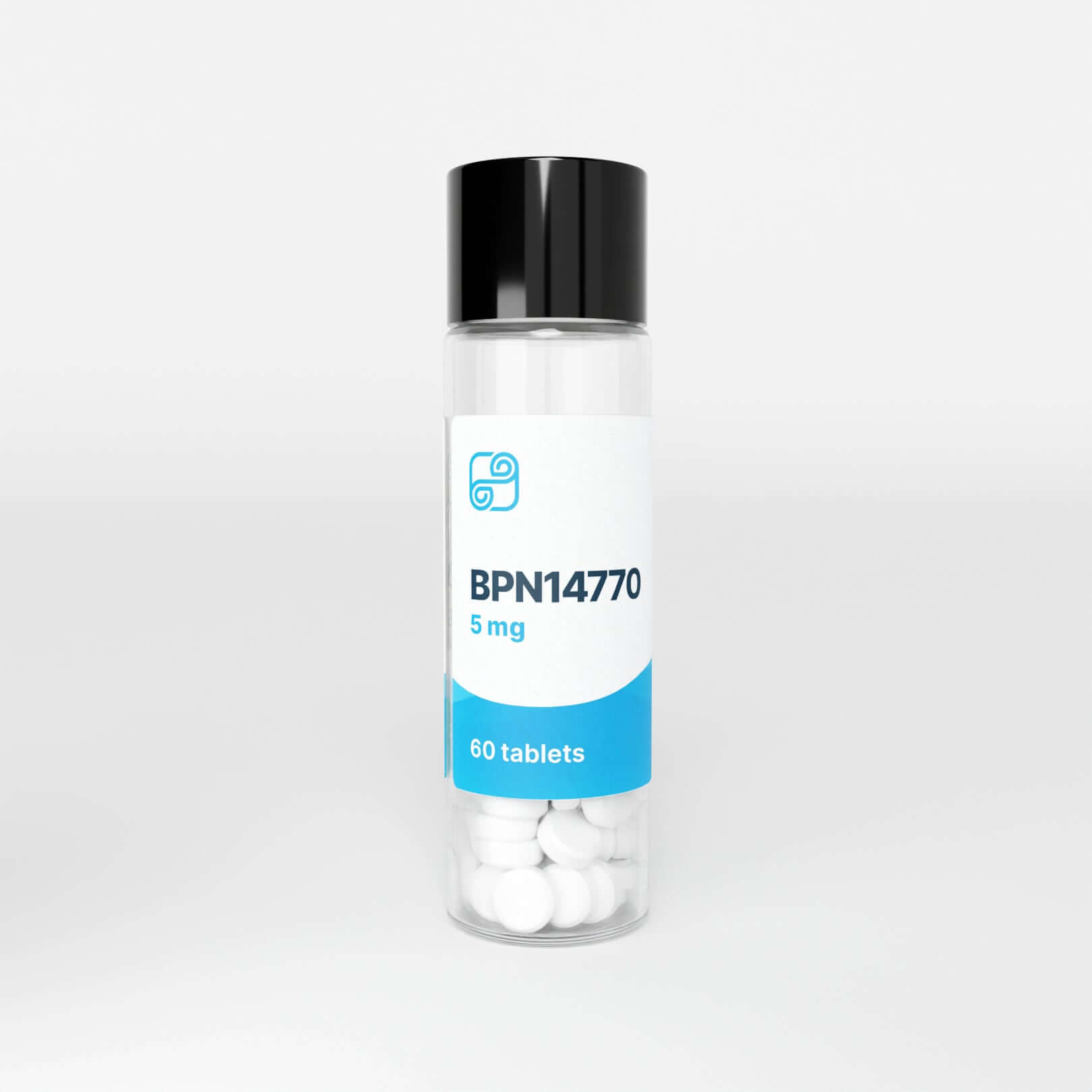
BPN14770 (Zatolmilast) 5 mg – 60 tablets
96.00€
Availability: 147 in stock
- Third Party Tested
- 14-Day Money Back Guarantee
- Fast Delivery Worldwide
Laboratory test for this product
View the certificate of analysis and laboratory verification for this product.
BPN14770 / Zatolmilast 5 mg — 60 oral research tablets. Zatolmilast (BPN14770) is the most clinically advanced selective allosteric inhibitor of phosphodiesterase 4D (PDE4D) ever developed — and arguably the most important new chemotype to emerge from intellectual-disability research in the past decade. Originally developed at Tetra Therapeutics (now part of Shionogi), BPN14770 has progressed through Phase II clinical trials in Fragile X syndrome with statistically significant improvements in cognitive composite scores, language and daily-living function, and is currently in Phase III development. Unlike older non-selective PDE4 inhibitors (rolipram, roflumilast), BPN14770’s allosteric mechanism preserves cAMP signaling under physiological conditions and produces dose-dependent cognitive enhancement without the emetic and tolerability ceiling that has limited the entire PDE4 class for decades.
Research Overview
Phosphodiesterase 4D (PDE4D) is the predominant cAMP-degrading enzyme in mammalian brain, and pharmacological inhibition of PDE4 has long been recognized as a potent strategy for enhancing memory and synaptic plasticity — first demonstrated decades ago with the prototype molecule rolipram [1]. The clinical promise of PDE4 inhibition has, however, been blocked for forty years by the emetic and GI side-effect profile shared by every non-selective PDE4 inhibitor, including the approved COPD drug roflumilast. BPN14770 is the first fundamentally new approach to this problem: it is a selective allosteric inhibitor of PDE4D that binds outside the catalytic site, producing partial — rather than complete — inhibition that preserves baseline cAMP signaling and abolishes the dose-limiting emesis [1,2]. In a Phase II RCT in adult males with Fragile X syndrome (Berry-Kravis et al., Nat Med 2021), 12-week BPN14770 produced statistically significant improvements in cognitive composite, language, and daily-living function — the first ever positive cognitive-endpoint result in any Fragile X clinical trial [2]. The compound has now advanced into Phase III development and is widely considered the most promising new pharmacological strategy for intellectual disability and age-related cognitive decline [3].
Primary Research Areas
- PDE4D allosteric inhibitor pharmacology — the lead clinical-stage allosteric PDE4D inhibitor; the cleanest available chemical probe of partial-inhibition pharmacology in the cAMP pathway [1,2].
- Fragile X syndrome research — the first molecule to produce a positive cognitive-endpoint signal in any Fragile X clinical trial — Phase II/III development in Fragile X is ongoing [2].
- Memory and synaptic plasticity — robust enhancement of LTP, working memory and long-term memory consolidation in rodent models [1].
- Neurodevelopmental and intellectual-disability research — investigated as a clinical-stage approach to genetic intellectual disabilities beyond Fragile X [3].
- Age-related cognitive decline — the partial-inhibition pharmacology and tolerability profile open the PDE4 class to chronic cognitive-aging research for the first time [1,3].
References
- Gurney ME, Cogram P, Deacon RM, Rex C, Tranfaglia M. Multiple behavior phenotypes of the fragile-X syndrome mouse model respond to chronic inhibition of phosphodiesterase-4D (PDE4D). Sci Rep. 2017;7(1):14653.
- Berry-Kravis EM, Harnett MD, Reines SA, et al. Inhibition of phosphodiesterase-4D in adults with fragile X syndrome: a randomized, placebo-controlled, Phase 2 clinical trial. Nat Med. 2021;27(5):862–870.
- Pelan SE, Anderson J, Beach J, et al. Selective inhibition of PDE4D for the treatment of fragile X syndrome and other intellectual disabilities. Pharmacol Ther. 2023;241:108310.
Find out what benefits peptides have
Discover how peptides can boost recovery, improve skin health, increase energy and support overall performance. Explained simply and clearly in this short video.
Why Limitless Biochem?
Limitless BioChem is a trusted supplier of research compounds. Our products meet strict quality standards and are compliant with EU requirements. We focus on the safe and reliable supply of peptides and pure compounds intended exclusively for research or collector purposes.
- Peptides, Nootropics, Amino acids...
- Products tested by an independent laboratory
- Exclusively pure compounds without additives
- Worldwide Delivery
- Warning
This product is not intended for human or veterinary use. It is for collection or research purposes only. It cannot be used as food, dietary supplement or medicine! The information provided in the text on this page is for educational purposes only and does not constitute medical or other advice.