- 15 000+ Verified Orders!
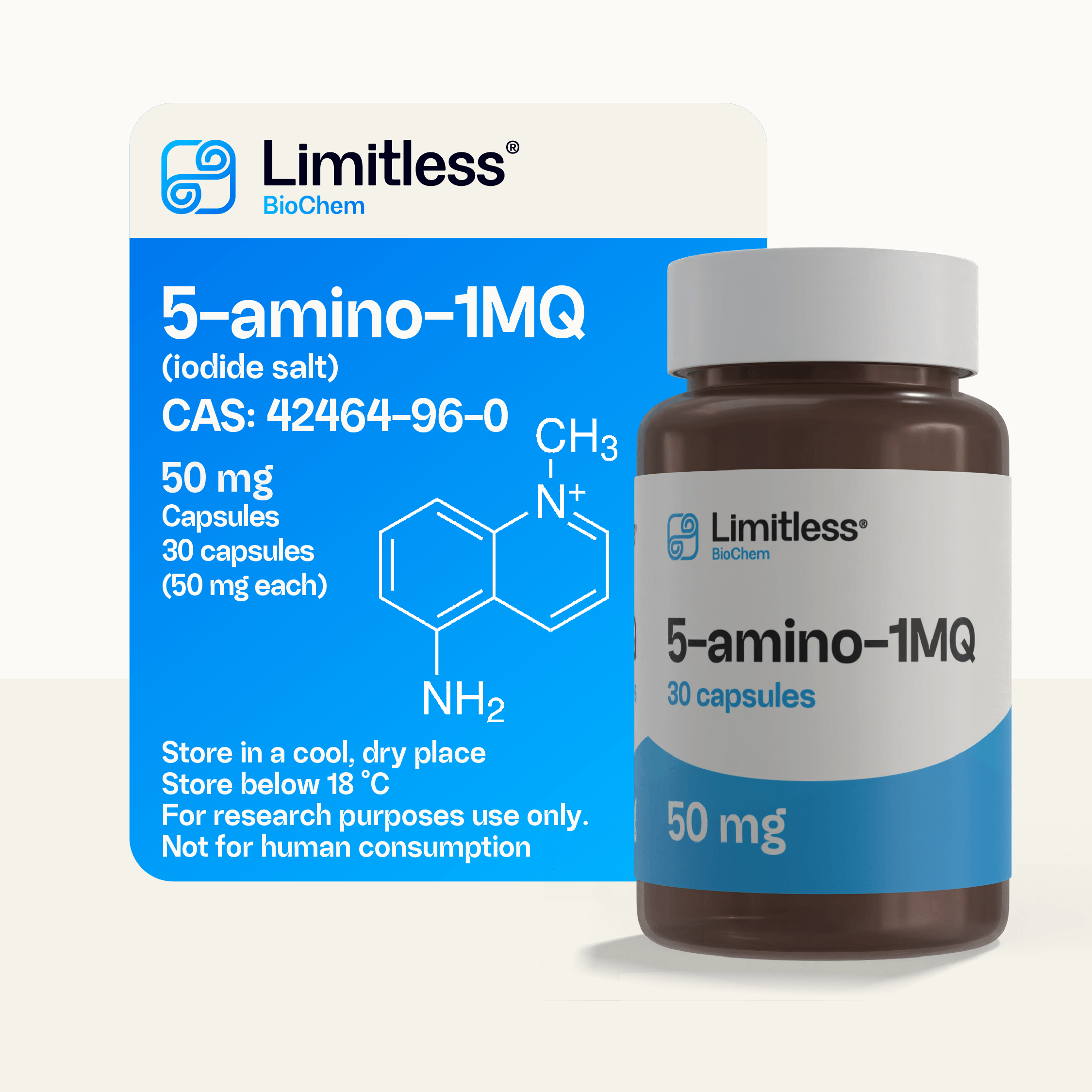
5-amino-1MQ 50 mg – 30 capsules
124.00€
Availability: 55 in stock
- Third Party Tested
- 14-Day Money Back Guarantee
- Fast Delivery Worldwide
Laboratory test for this product
View the certificate of analysis and laboratory verification for this product.
5-Amino-1MQ 50 mg — 30 oral research capsules. 5-Amino-1-methylquinolinium iodide is the lead first-in-class small-molecule inhibitor of nicotinamide N-methyltransferase (NNMT) — an enzyme overexpressed in white adipose tissue of obese individuals where it consumes the methyl-donor pool and depletes tissue NAD⁺. In landmark mouse studies, oral 5-amino-1MQ produced robust reductions in adipocyte size, body fat and inflammatory adipokines while leaving food intake unchanged — pointing to a fundamentally novel “metabolic-rejuvenation” mechanism that operates entirely on the methylation–NAD axis. The 50 mg per-capsule format mirrors the daily oral dose used in published rodent pharmacology.
Research Overview
Nicotinamide N-methyltransferase (NNMT) catalyzes the transfer of a methyl group from S-adenosyl-L-methionine (SAM) to nicotinamide, producing 1-methylnicotinamide and S-adenosyl-L-homocysteine [1]. In white adipose tissue of obese, insulin-resistant and aged mammals, NNMT is dramatically upregulated — and because it consumes both the universal methyl donor (SAM) and the NAD⁺ precursor (nicotinamide), its hyperactivity simultaneously depletes the cellular methylation reserve and the NAD-salvage pool [1,2]. 5-Amino-1MQ is the lead potent, selective small-molecule inhibitor of NNMT identified to date. Oral administration to diet-induced-obese mice for ~10 days reduces fat mass without altering food intake, decreases adipocyte size, restores insulin sensitivity, and increases adipose NAD⁺ and SAM levels [2]. In aged rodents, the same pharmacology has been extended to skeletal-muscle pathology, where it preserves muscle stem cell function and mitigates sarcopenia [3]. The molecule has become the canonical chemical probe for the entire NNMT–methylation–NAD axis and is the foundation for a growing field of “methylation-rejuvenation” research.
Primary Research Areas
- NNMT enzymology and pharmacology — the lead first-in-class selective small-molecule NNMT inhibitor used to validate the entire target class [7].
- Adipose biology and obesity research — robust reductions in adipocyte size and white-adipose mass in DIO mice without changes in food intake — a phenotype distinct from any approved anti-obesity mechanism [1,2,7].
- Cellular methylation and NAD⁺ pool dynamics — the only well-characterized chemical probe that simultaneously raises tissue NAD⁺ and SAM, enabling clean studies of the methyl-donor / NAD-salvage interface [7].
- Muscle aging and sarcopenia — preserves quiescent muscle-stem-cell pool and ameliorates aged-muscle dysfunction in rodent studies of sarcopenia [8].
- Metabolic-rejuvenation and longevity research — central to an emerging research framework that connects methylation tone, NAD⁺ availability and tissue-specific aging [2,8].
- Fatty liver — obese mice on 28 days of 5A1MQ had less fat in the liver, fewer inflammatory macrophages there, smaller and lighter livers and lower liver triglycerides, and their ALT and AST readings returned to normal. Adding the drug to a lean diet cleared liver fat further than the diet alone [1,2].
- Blood sugar and insulin — the same 28-day course in diet-induced obese mice improved oral glucose tolerance and insulin sensitivity and brought down the high insulin levels those mice carry. This is mouse work; no one has measured glucose control in people on this compound [1].
- Gut bacteria shift — obese mice given 5-amino-1-methylquinolinium alongside a switch to low-fat food developed a distinct gut flora, with less Erysipelatoclostridium and more Lactobacillus than mice switched to the same food without the drug. Both genera are linked to body weight, though what this means for a person is unknown [3].
- Tumour growth in mice — 5-amino-1-methylquinolinium iodide slowed bladder-tumour growth in mice and made an anti-PD-L1 antibody kill more cancer cells, and in the dish it stopped HeLa cervical cancer cells dividing while apparently leaving normal HEK-293 cells alone. None of this is human treatment data [4,5].
- Grip strength on top of exercise — sedentary 22-month-old mice treated for two months gripped about 40 per cent harder than controls, while exercise alone gave 20 per cent, and the two combined gave 60 per cent. The effects added up rather than overlapping, so it does not simply substitute for training [6].
References
- Babula JJ, Bui D, Stevenson HL, et al. Nicotinamide N-methyltransferase inhibition mitigates obesity-related metabolic dysfunction. Diabetes Obes Metab. 2024;26(11):5272-5282. PMID 39161060. doi:10.1111/dom.15879
- Sampson CM, Dimet AL, Neelakantan H, et al. Combined nicotinamide N-methyltransferase inhibition and reduced-calorie diet normalizes body composition and enhances metabolic benefits in obese mice. Sci Rep. 2021;11(1):5637. PMID 33707534. doi:10.1038/s41598-021-85051-6
- Dimet-Wiley A, Wu Q, Wiley JT, et al. Reduced calorie diet combined with NNMT inhibition establishes a distinct microbiome in DIO mice. Sci Rep. 2022;12(1):484. PMID 35013352. doi:10.1038/s41598-021-03670-5
- Yang M, Wang B, Hou W, et al. NADmetabolism enzyme NNMT in cancer-associated fibroblasts drives tumor progression and resistance to immunotherapy by modulating macrophages in urothelial bladder cancer. J Immunother Cancer. 2024;12(7). PMID 39067875. doi:10.1136/jitc-2024-009281
- Akar S, Duran T, Azzawri AA, et al. Small molecule inhibitor of nicotinamide N-methyltransferase shows anti-proliferative activity in HeLa cells. J Obstet Gynaecol. 2021;41(8):1240-1245. PMID 33645410. doi:10.1080/01443615.2020.1854696
- Dimet-Wiley AL, Latham CM, Brightwell CR, et al. Nicotinamide N-methyltransferase inhibition mimics and boosts exercise-mediated improvements in muscle function in aged mice. Sci Rep. 2024;14(1):15554. PMID 38969654. doi:10.1038/s41598-024-66034-9
- Neelakantan H, Vance V, Wetzel MD, et al. Selective and membrane-permeable small molecule inhibitors of nicotinamide N-methyltransferase reverse high fat diet-induced obesity in mice. Biochem Pharmacol. 2018;147:141-152. PMID 29155147. doi:10.1016/j.bcp.2017.11.007
- Neelakantan H, Brightwell CR, Graber TG, et al. Small molecule nicotinamide N-methyltransferase inhibitor activates senescent muscle stem cells and improves regenerative capacity of aged skeletal muscle. Biochem Pharmacol. 2019;163:481-492. PMID 30753815. doi:10.1016/j.bcp.2019.02.008
Find out what benefits peptides have
Discover how peptides can boost recovery, improve skin health, increase energy and support overall performance. Explained simply and clearly in this short video.
Why Limitless Biochem?
Limitless BioChem is a trusted supplier of research compounds. Our products meet strict quality standards and are compliant with EU requirements. We focus on the safe and reliable supply of peptides and pure compounds intended exclusively for research or collector purposes.
- Peptides, Nootropics, Amino acids...
- Products tested by an independent laboratory
- Exclusively pure compounds without additives
- Worldwide Delivery
- Warning
This product is not intended for human or veterinary use. It is for collection or research purposes only. It cannot be used as food, dietary supplement or medicine! The information provided in the text on this page is for educational purposes only and does not constitute medical or other advice.