- 15 000+ Verified Orders!
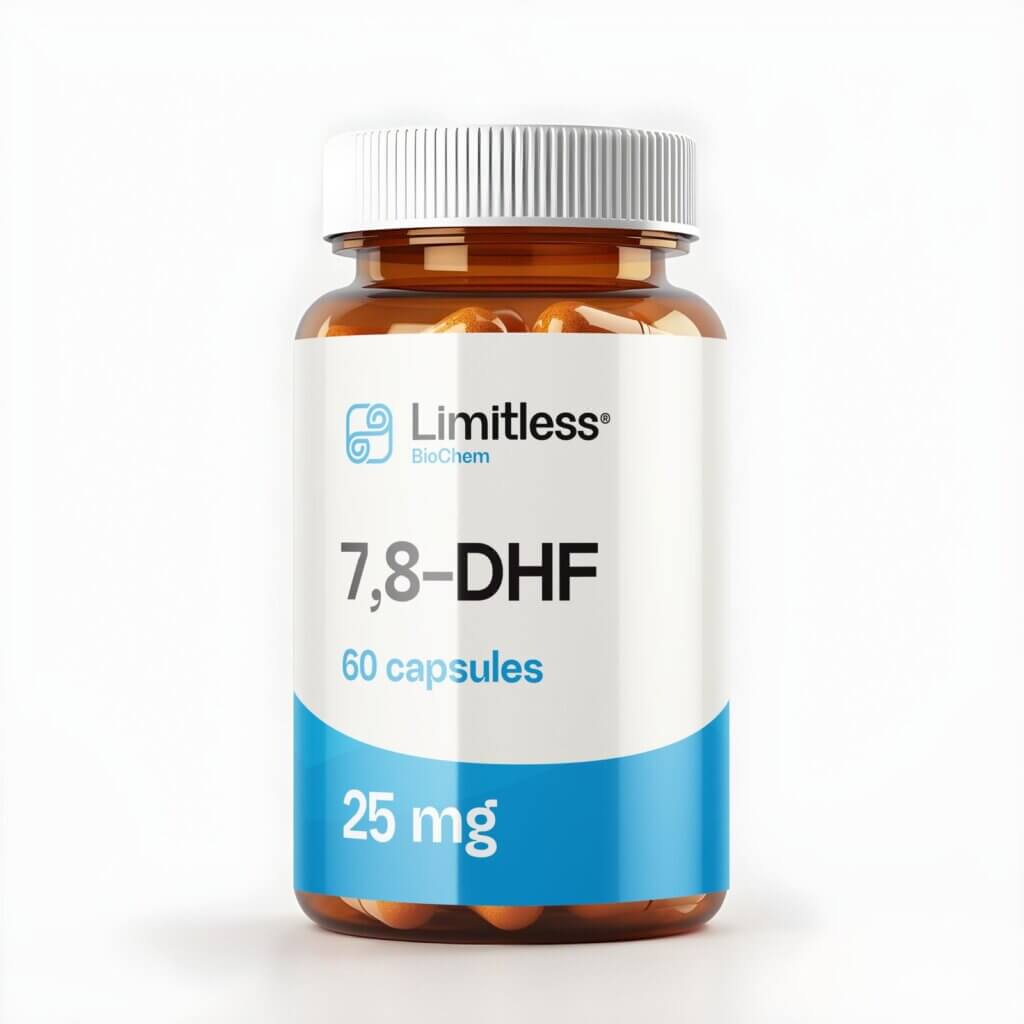
7,8-DHF 25 mg – 60 capsules
59.99€
Availability: 80 in stock
- Third Party Tested
- 14-Day Money Back Guarantee
- Fast Delivery Worldwide
Laboratory test for this product
View the certificate of analysis and laboratory verification for this product.
7,8-Dihydroxyflavone (7,8-DHF) 25 mg — 60 oral research capsules. 7,8-Dihydroxyflavone is the most pharmacologically convincing small-molecule TrkB receptor agonist ever characterized — and the principal research tool molecule for studying brain-derived neurotrophic factor (BDNF) signaling in vivo. Discovered in the laboratory of Keqiang Ye at Emory University, 7,8-DHF crosses the blood-brain barrier readily after oral administration and binds directly to the BDNF receptor TrkB, mimicking the activity of the parent neurotrophin in a way that BDNF itself cannot achieve (BDNF being a 27 kDa protein incapable of crossing the BBB). The compound has produced striking effects in models of Alzheimer’s, Parkinson’s, depression, stroke, Rett syndrome and Huntington’s disease.
Research Overview
Brain-derived neurotrophic factor (BDNF) is the master neurotrophin of the adult mammalian brain — the principal endogenous regulator of neuronal survival, synaptic plasticity, long-term potentiation, adult hippocampal neurogenesis and antidepressant response [1]. BDNF signals exclusively through the TrkB receptor (tropomyosin receptor kinase B), and reduced BDNF / TrkB signaling has been documented in essentially every major neuropsychiatric and neurodegenerative disease — Alzheimer’s, Parkinson’s, depression, schizophrenia, Huntington’s, Rett syndrome [1]. Direct administration of recombinant BDNF, however, has proven impossible: the protein has a vanishingly short circulating half-life and cannot cross the blood-brain barrier. 7,8-Dihydroxyflavone — discovered in a high-throughput screen by Keqiang Ye’s group at Emory University — is the first orally bioavailable, BBB-permeant small-molecule TrkB receptor agonist that produces the full TrkB phosphorylation signature of BDNF itself [2]. In published in-vivo work, 7,8-DHF has produced reproducible therapeutic phenotypes in transgenic mouse models of Alzheimer’s, Parkinson’s, depression, Rett syndrome, Huntington’s disease and stroke, with rescue of memory, motor function and synaptic plasticity at the 5–25 mg/kg oral dose range [2,3]. The compound has emerged as the canonical research tool for BDNF/TrkB pharmacology in vivo.
Primary Research Areas
- TrkB receptor agonist pharmacology — the most pharmacologically convincing orally bioavailable, BBB-permeant TrkB agonist in the published literature; the canonical research tool for BDNF / TrkB signaling in vivo [1,2].
- Alzheimer’s disease and cognitive deficit research — rescue of memory and amyloid-pathology endpoints in 5xFAD and APP/PS1 transgenic mouse models [1].
- Depression and neuroplasticity research — antidepressant-like effects in chronic-stress and forced-swim models, with synaptic-plasticity rescue [2].
- Stroke and traumatic brain injury — neuroprotective signals in middle-cerebral-artery-occlusion and TBI models with reduction of infarct volume [7].
- Rett syndrome and Huntington’s — rescue of motor-function deficits and lifespan extension in genetic models of both conditions [8].
- Body weight and blood sugar — obese female mice, thirteen weeks into a high-fat diet, were given 7,8-DHF for nine weeks. They built more mitochondria in skeletal muscle, burned more energy, gained less weight, and their raised blood fats, blood sugar and insulin all came down. It is mice, females only, and nothing comparable has been tried in a person [3].
- Broken bones mended worse — mice with a closed break in the shin bone were given 5 mg/kg a day for two weeks. Four weeks later the healing callus was smaller and mechanically weaker than in untreated mice, by a route the authors could not identify. The finding concerns bone healing after a fracture in mice [4].
- Opposite effects in males and females — given before each session in which mice were taught that a warning cue no longer meant danger, 7,8-DHF helped males let go of the fear but made it harder for females; given straight after it did neither. A different group, on a different schedule, found the reverse in females. Both are single mouse studies [5,6].
- Breathing in a Rett model — mice carrying a mutation in the Mecp2 gene, the cause of Rett syndrome, were given 7,8-DHF in their drinking water from weaning. They lived longer (80 days against 66), lost weight later, ran further on a wheel, and had their irregular breathing partly corrected. It is a mouse model of a rare genetic condition [8].
- How much of it gets in — the laboratory that discovered the molecule calls its oral bioavailability only modest, and that is why they built an ester prodrug (R13) to raise blood levels and brain exposure. Much of the TrkB activation comes from methylated by-products, and a COMT inhibitor cut the effect. So a swallowed dose is not a delivered dose [1,2].
References
- Chen C, Wang Z, Zhang Z, et al. The prodrug of 7,8-dihydroxyflavone development and therapeutic efficacy for treating Alzheimer’s disease. Proc Natl Acad Sci U S A. 2018;115(3):578-583. PMID 29295929. doi:10.1073/pnas.1718683115
- Liu X, Qi Q, Xiao G, et al. O-methylated metabolite of 7,8-dihydroxyflavone activates TrkB receptor and displays antidepressant activity. Pharmacology. 2013;91(3-4):185-200. PMID 23445871. doi:10.1159/000346920
- Wood J, Tse MCL, Yang X, et al. BDNF mimetic alleviates body weight gain in obese mice by enhancing mitochondrial biogenesis in skeletal muscle. Metabolism. 2018;87:113-122. PMID 29935237. doi:10.1016/j.metabol.2018.06.007
- Johnstone MR, Brady RD, Church JE, et al. The TrkB agonist, 7,8-dihydroxyflavone, impairs fracture healing in mice. J Musculoskelet Neuronal Interact. 2021;21(2):263-271. PMID 34059571.
- Tohyama S, Matsuda S, Mizutani A. Sex-dependent opposite effects of a tropomyosin-related kinase B receptor (TrkB) agonist 7,8-dihydroxyflavone on cued fear extinction in mice. Neurosci Lett. 2020;715:134670. PMID 31805374. doi:10.1016/j.neulet.2019.134670
- Baker-Andresen D, Flavell CR, Li X, et al. Activation of BDNF signaling prevents the return of fear in female mice. Learn Mem. 2013;20(5):237-40. PMID 23589089. doi:10.1101/lm.029520.112
- Wang B, Wu N, Liang F, et al. 7,8-dihydroxyflavone, a small-molecule tropomyosin-related kinase B (TrkB) agonist, attenuates cerebral ischemia and reperfusion injury in rats. J Mol Histol. 2014;45(2):129-40. PMID 24045895. doi:10.1007/s10735-013-9539-y
- Johnson RA, Lam M, Punzo AM, et al. 7,8-dihydroxyflavone exhibits therapeutic efficacy in a mouse model of Rett syndrome. J Appl Physiol (1985). 2012;112(5):704-10. PMID 22194327. doi:10.1152/japplphysiol.01361.2011
Find out what benefits peptides have
Discover how peptides can boost recovery, improve skin health, increase energy and support overall performance. Explained simply and clearly in this short video.
Why Limitless Biochem?
Limitless BioChem is a trusted supplier of research compounds. Our products meet strict quality standards and are compliant with EU requirements. We focus on the safe and reliable supply of peptides and pure compounds intended exclusively for research or collector purposes.
- Peptides, Nootropics, Amino acids...
- Products tested by an independent laboratory
- Exclusively pure compounds without additives
- Worldwide Delivery
- Warning
This product is not intended for human or veterinary use. It is for collection or research purposes only. It cannot be used as food, dietary supplement or medicine! The information provided in the text on this page is for educational purposes only and does not constitute medical or other advice.