- 15 000+ Verified Orders!
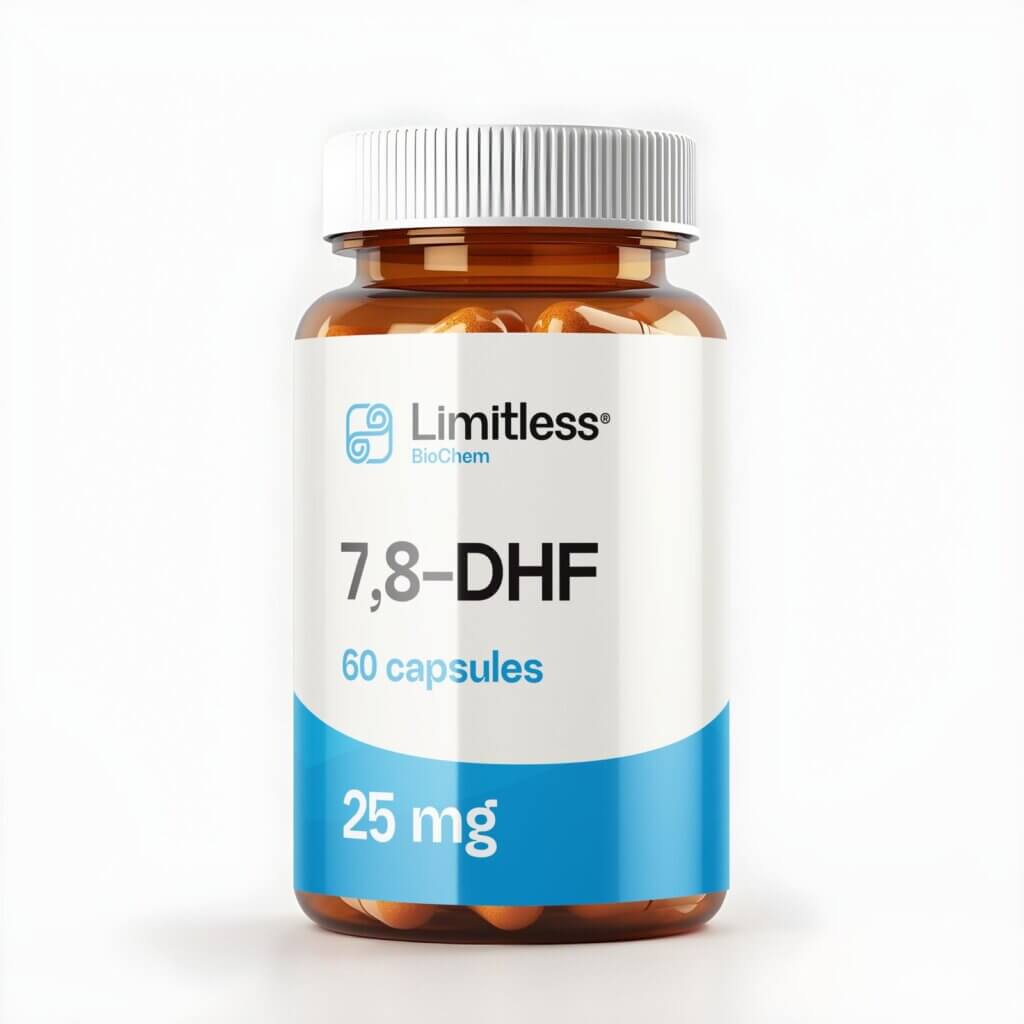
7,8-DHF 25 mg – 60 capsules
59.99€
- Third Party Tested
- 14-Day Money Back Guarantee
- Fast Delivery Worldwide
Laboratory test for this product
View the certificate of analysis and laboratory verification for this product.
7,8-Dihydroxyflavone (7,8-DHF) 25 mg — 60 oral research capsules. 7,8-Dihydroxyflavone is the most pharmacologically convincing small-molecule TrkB receptor agonist ever characterized — and the principal research tool molecule for studying brain-derived neurotrophic factor (BDNF) signaling in vivo. Discovered in the laboratory of Keqiang Ye at Emory University, 7,8-DHF crosses the blood-brain barrier readily after oral administration and binds directly to the BDNF receptor TrkB, mimicking the activity of the parent neurotrophin in a way that BDNF itself cannot achieve (BDNF being a 27 kDa protein incapable of crossing the BBB). The compound has produced striking effects in models of Alzheimer’s, Parkinson’s, depression, stroke, Rett syndrome and Huntington’s disease.
Research Overview
Brain-derived neurotrophic factor (BDNF) is the master neurotrophin of the adult mammalian brain — the principal endogenous regulator of neuronal survival, synaptic plasticity, long-term potentiation, adult hippocampal neurogenesis and antidepressant response [1]. BDNF signals exclusively through the TrkB receptor (tropomyosin receptor kinase B), and reduced BDNF / TrkB signaling has been documented in essentially every major neuropsychiatric and neurodegenerative disease — Alzheimer’s, Parkinson’s, depression, schizophrenia, Huntington’s, Rett syndrome [1]. Direct administration of recombinant BDNF, however, has proven impossible: the protein has a vanishingly short circulating half-life and cannot cross the blood-brain barrier. 7,8-Dihydroxyflavone — discovered in a high-throughput screen by Keqiang Ye’s group at Emory University — is the first orally bioavailable, BBB-permeant small-molecule TrkB receptor agonist that produces the full TrkB phosphorylation signature of BDNF itself [2]. In published in-vivo work, 7,8-DHF has produced reproducible therapeutic phenotypes in transgenic mouse models of Alzheimer’s, Parkinson’s, depression, Rett syndrome, Huntington’s disease and stroke, with rescue of memory, motor function and synaptic plasticity at the 5–25 mg/kg oral dose range [2,3]. The compound has emerged as the canonical research tool for BDNF/TrkB pharmacology in vivo.
Primary Research Areas
- TrkB receptor agonist pharmacology — the most pharmacologically convincing orally bioavailable, BBB-permeant TrkB agonist in the published literature; the canonical research tool for BDNF / TrkB signaling in vivo [1,2].
- Alzheimer’s disease and cognitive deficit research — rescue of memory and amyloid-pathology endpoints in 5xFAD and APP/PS1 transgenic mouse models [2,3].
- Depression and neuroplasticity research — antidepressant-like effects in chronic-stress and forced-swim models, with synaptic-plasticity rescue [2].
- Stroke and traumatic brain injury — neuroprotective signals in middle-cerebral-artery-occlusion and TBI models with reduction of infarct volume [2,3].
- Rett syndrome and Huntington’s — rescue of motor-function deficits and lifespan extension in genetic models of both conditions [3].
References
- Lu B, Nagappan G, Lu Y. BDNF and synaptic plasticity, cognitive function, and dysfunction. Handb Exp Pharmacol. 2014;220:223–250.
- Jang SW, Liu X, Yepes M, et al. A selective TrkB agonist with potent neurotrophic activities by 7,8-dihydroxyflavone. Proc Natl Acad Sci USA. 2010;107(6):2687–2692.
- Liu C, Chan CB, Ye K. 7,8-Dihydroxyflavone, a small molecular TrkB agonist, is useful for treating various BDNF-implicated human disorders. Transl Neurodegener. 2016;5:2.
Find out what benefits peptides have
Discover how peptides can boost recovery, improve skin health, increase energy and support overall performance. Explained simply and clearly in this short video.
Why Limitless Biochem?
Limitless BioChem is a trusted supplier of research compounds. Our products meet strict quality standards and are compliant with EU requirements. We focus on the safe and reliable supply of peptides and pure compounds intended exclusively for research or collector purposes.
- Peptides, Nootropics, Amino acids...
- Products tested by an independent laboratory
- Exclusively pure compounds without additives
- Worldwide Delivery
- Warning
This product is not intended for human or veterinary use. It is for collection or research purposes only. It cannot be used as food, dietary supplement or medicine! The information provided in the text on this page is for educational purposes only and does not constitute medical or other advice.