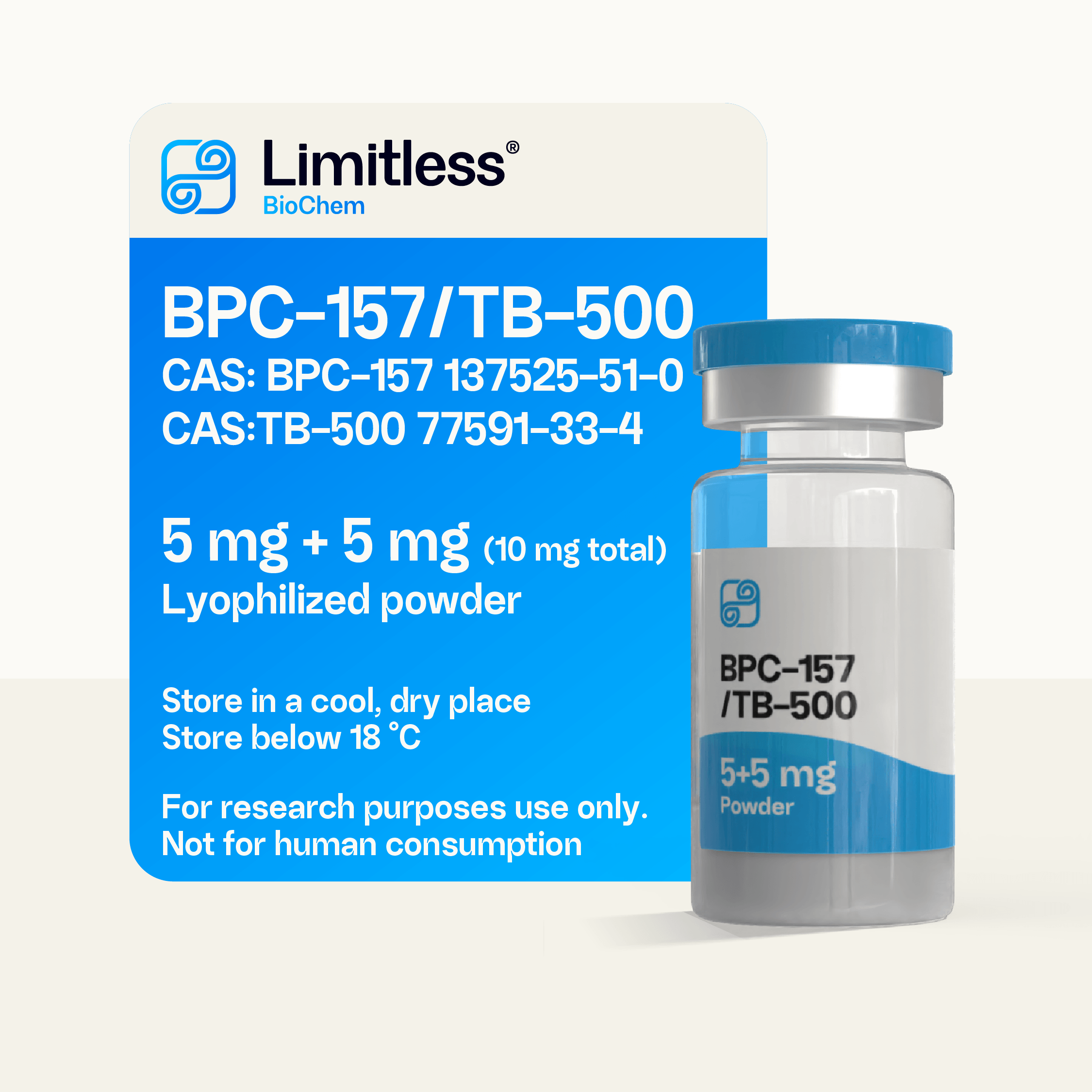
BPC-157 / TB-500 Blend 5 mg + 5 mg research-grade lyophilized peptide powder in a glass vial. This blend contains 5 mg BPC-157 and 5 mg TB-500 co-lyophilized for use in laboratory models exploring synergistic tissue repair, regeneration, angiogenesis and cell-migration pathways.
All products are intended exclusively for laboratory and scientific research. Not for human or veterinary use.
Research Overview
This blend combines BPC-157, a gastric pentadecapeptide, with TB-500, a synthetic form of thymosin β4. In experimental systems it is used to explore synergistic tissue repair and regeneration mechanisms involving angiogenesis, cell migration and cytoskeletal dynamics.
Primary Research Areas
- Synergistic tissue repair & regeneration: models combining BPC-157 and TB-500 to evaluate coordinated effects on tissue integrity and recovery dynamics [1].
- Angiogenesis & microvascular remodeling: studies of blood-vessel formation, microcirculation and endothelial responses in repair frameworks [2,3].
- Cell migration & actin-related processes: experimental systems focusing on cytoskeletal organization, motility and TB-500–linked actin dynamics [3].
- Inflammation & soft-tissue models: research on local and systemic inflammatory markers in musculoskeletal and soft-tissue repair setups [4].
- Painkiller damage to the gut (BPC-157): rats given diclofenac, ibuprofen, aspirin, paracetamol or celecoxib lost pressure in the valves at both ends of the stomach; BPC-157 given straight after, by injection or in drinking water, brought those pressures back to normal. Rats only, but it points to an interaction with everyday painkillers [5].
- Cut nerves in rats (BPC-157): after the sciatic nerve was cut and repaired, rats given 10 µg/kg or 10 ng/kg regrew thicker myelin and more nerve fibres, showed stronger muscle electrical signals and walked better, and stopped biting the numb foot. Rats, and the peptide was given straight after the injury [6].
- After a heart attack (TB-500): mice had a coronary artery tied off and were then given thymosin beta-4, the parent molecule of TB-500; more heart-muscle cells survived the first days and heart pumping improved. It also kept heart cells alive and moving in culture. Mice, and injected, not swallowed [7].
- Brain tumour invasiveness (TB-500): thymosin beta-4 levels rose with the grade of human brain tumours, and switching the gene off in glioma cells stopped them migrating and invading and made tumour-bearing mice live longer. This is the peptide’s own gene in cancer cells, not injected TB-500, and giving the peptide was not tested [8].
References
- Biçer O, Adanir O, Güleryüz Y, et al. Effects of BPC-157 and TB-500 on Achilles tendon healing in rats: A histopathological and biomechanical study. Jt Dis Relat Surg. 2026;37(3):822-837. PMID 42542926. doi:10.52312/jdrs.2026.2951
- Huang T, Zhang K, Sun L, et al. Body protective compound-157 enhances alkali-burn wound healing in vivo and promotes proliferation, migration, and angiogenesis in vitro. Drug Des Devel Ther. 2015;9:2485-99. PMID 25995620. doi:10.2147/DDDT.S82030
- Philp D, Huff T, Gho YS, et al. The actin binding site on thymosin beta4 promotes angiogenesis. FASEB J. 2003;17(14):2103-5. PMID 14500546. doi:10.1096/fj.03-0121fje
- Pevec D, Novinscak T, Brcic L, et al. Impact of pentadecapeptide BPC 157 on muscle healing impaired by systemic corticosteroid application. Med Sci Monit. 2010;16(3):BR81-88. PMID 20190676.
- Vitaic S, Stupnisek M, Drmic D, et al. Nonsteroidal anti-inflammatory drugs-induced failure of lower esophageal and pyloric sphincter and counteraction of sphincters failure with stable gatric pentadecapeptide BPC 157 in rats. J Physiol Pharmacol. 2017;68(2):265-272. PMID 28614776.
- Gjurasin M, Miklic P, Zupancic B, et al. Peptide therapy with pentadecapeptide BPC 157 in traumatic nerve injury. Regul Pept. 2010;160(1-3):33-41. PMID 19903499. doi:10.1016/j.regpep.2009.11.005
- Bock-Marquette I, Saxena A, White MD, et al. Thymosin beta4 activates integrin-linked kinase and promotes cardiac cell migration, survival and cardiac repair. Nature. 2004;432(7016):466-72. PMID 15565145. doi:10.1038/nature03000
- Wirsching HG, Krishnan S, Florea AM, et al. Thymosin β 4 gene silencing decreases stemness and invasiveness in glioblastoma. Brain. 2014;137(Pt 2):433-48. PMID 24355709. doi:10.1093/brain/awt333
Recommended solvent — Bacteriostatic water

For diluting lyophilized peptide powders, use a sterile and suitable research solvent such as bacteriostatic water (BAC), which may help support handling stability and reduce contamination risk.
For convenient laboratory use, see Bacteriostatic Water – 10 ml.