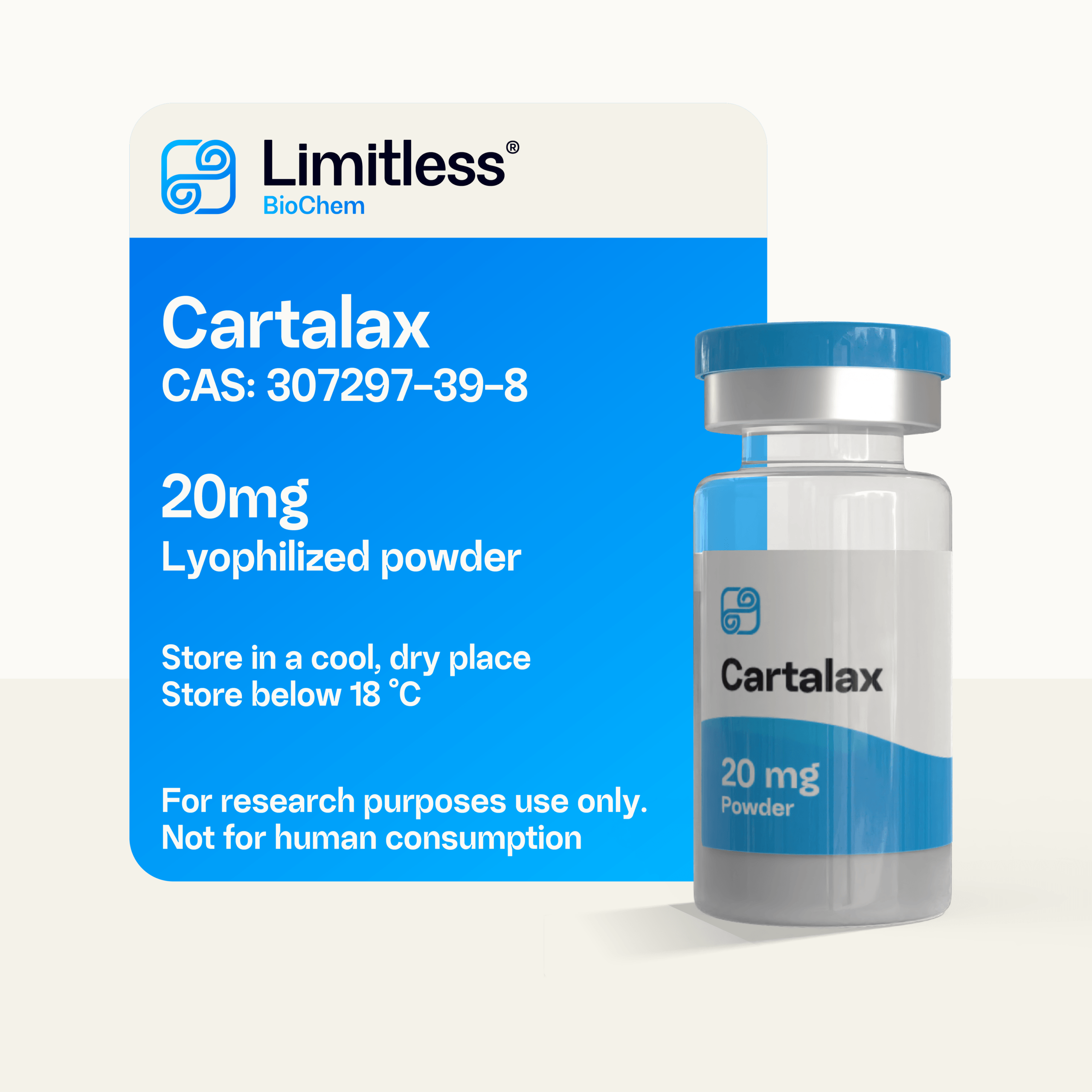
Cartalax 20 mg research-grade lyophilized peptide powder in a glass vial. Cartalax is a synthetic tripeptide bioregulator with the sequence Ala-Glu-Asp (AED), studied in experimental models of musculoskeletal and cartilage tissue, cellular aging and gene-expression regulation.
Research Overview
Cartalax (AED tripeptide) is used in experimental bioregulator research to investigate musculoskeletal tissue homeostasis, cellular-aging markers and gene-expression profiles in cartilage and bone cells. Studies focus on how short regulatory peptides may influence cellular proliferation, differentiation and stress responses in vitro and in vivo laboratory models, without implying any therapeutic application.
Primary Research Areas
- Cartilage & bone tissue models: Musculoskeletal research exploring extracellular matrix turnover, chondrocyte and osteoblast activity, and structural maintenance of cartilage and bone tissue.
- Cellular aging: Experimental systems examining how short bioregulator peptides affect cellular senescence markers and longevity-related signaling [1].
- Gene-expression regulation: In vitro models investigating modulation of gene-expression networks in musculoskeletal and related cell types under various stress and adaptation conditions [1].
- Kidney cells kept renewing: in kidney tissue from young and old rats, the AED tripeptide increased cell growth and reduced cell death, though less strongly than the whole kidney extract it was derived from. A second study found the same renewal effect in ageing kidney cells [2,3].
- Ageing skin cells: in skin fibroblasts aged in a dish, AED held down MMP-9, the collagen-breaking enzyme that rises with age, raised two markers of growth and repair, and blocked caspase-driven cell death. Nothing here was tested on an animal or a person [4].
- The IGF-1 gene turned up: in human bone-marrow stem cells aged in culture, nanomolar AED raised IGF-1 gene activity three-and-a-half to nearly six fold. IGF-1 drives growth and repair, but only the gene was measured, not the protein, and only in cells [5].
- It also switched on NF-kB: the same stem-cell study found AED raised activity of the NF-kB gene, the master switch for inflammation, in both ageing models it tested. The finding concerns inflammatory conditions, though no inflammation was actually measured [5].
- Nerve markers, in a mixture: human dental stem cells grown with a four-peptide mix containing AED made more of two proteins found in young nerve cells. The effect was shown for the mix and for KED alone, so what AED contributes by itself is not known [6].
References
- Khavinson VKh, Tarnovskaia SI, Lin’kova NS, et al. [Tripeptides slow down aging process in renal cell culture]. Adv Gerontol. 2014;27(4):651-6. PMID 25946838.
- Chalisova NI, Lin’kova NS, Nichik TE, et al. Peptide Regulation of Cells Renewal Processes in Kidney Tissue Cultures from Young and Old Animals. Bull Exp Biol Med. 2015;159(1):124-7. PMID 26033601. doi:10.1007/s10517-015-2906-9
- Khavinson VKh, Lin’kova NS, Polyakova VO, et al. Peptides regulate expression of signaling molecules in kidney cell cultures during in vitro aging. Bull Exp Biol Med. 2014;157(2):261-4. PMID 24958378. doi:10.1007/s10517-014-2540-y
- Lin’kova NS, Drobintseva AO, Orlova OA, et al. Peptide Regulation of Skin Fibroblast Functions during Their Aging In Vitro. Bull Exp Biol Med. 2016;161(1):175-8. PMID 27259496. doi:10.1007/s10517-016-3370-x
- Ashapkin V, Khavinson V, Shilovsky G, et al. Gene expression in human mesenchymal stem cell aging cultures: modulation by short peptides. Mol Biol Rep. 2020;47(6):4323-4329. PMID 32399807. doi:10.1007/s11033-020-05506-3
- Caputi S, Trubiani O, Sinjari B, et al. Effect of short peptides on neuronal differentiation of stem cells. Int J Immunopathol Pharmacol. 2019;33:2058738419828613. PMID 30791821. doi:10.1177/2058738419828613
Recommended solvent — Bacteriostatic water

For diluting lyophilized peptide powders, use a sterile and suitable research solvent such as bacteriostatic water (BAC), which may help support handling stability and reduce contamination risk.
For convenient laboratory use, see Bacteriostatic Water – 10 ml.