- 15 000+ Verified Orders!
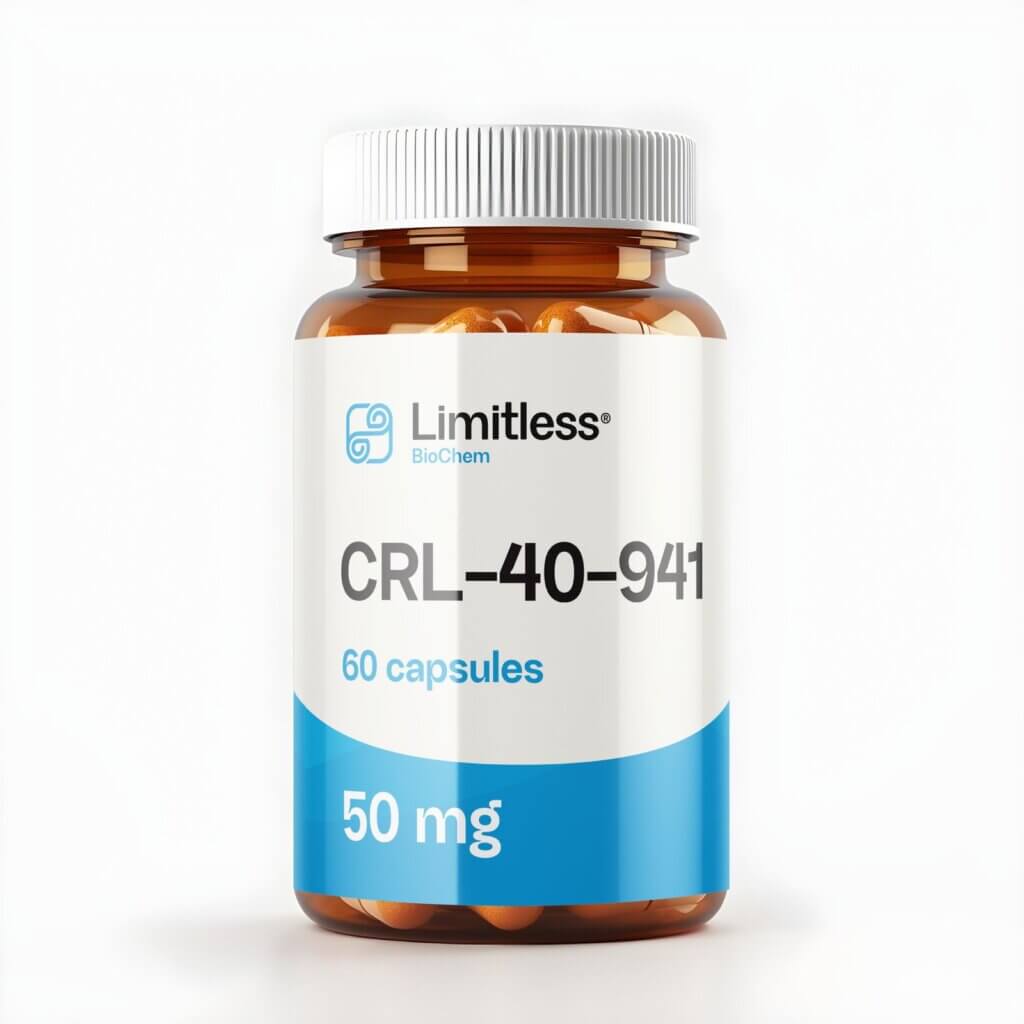
CRL-40-941 50 mg – 60 capsules
49.99€
Availability: 26 in stock
- Third Party Tested
- 14-Day Money Back Guarantee
- Fast Delivery Worldwide
Laboratory test for this product
View the certificate of analysis and laboratory verification for this product.
CRL-40,941 (Fladrafinil / Bisfluoroadrafinil) 50 mg — 60 research capsules. CRL-40,941 — also known as fladrafinil or bisfluoroadrafinil — is the bis-(p-fluoro) analogue of adrafinil and a close relative of modafinil, the gold-standard wakefulness-promoting agent approved for narcolepsy, shift-work sleep disorder and obstructive sleep apnea. Originally developed at Cephalon and the Laboratoire L. Lafon (the same program that produced modafinil and adrafinil), CRL-40,941 belongs, like adrafinil, to the modafinil class of wakefulness-promoting agents, characterised by the absence of the locomotor activation, anxiety, sympathetic tone and abuse liability typical of classical psychostimulants; direct published data on CRL-40,941 itself are limited.
Research Overview
CRL-40,941 is the bis-(p-fluoro)-adrafinil analogue developed at Laboratoire L. Lafon (now Cephalon / Teva) as part of the same medicinal-chemistry program that produced modafinil (CRL-40,476) and adrafinil (CRL-40,028) [1]. Compounds of this class act principally at the dopamine transporter (DAT), with secondary effects on noradrenergic and orexinergic systems [1,2]; comparable binding data for CRL-40,941 itself have not been published. The two para-fluorine substitutions on the diphenylmethyl scaffold distinguish it from adrafinil and are expected to increase lipophilicity and metabolic stability. Modafinil-class compounds show a distinctive “clean wakefulness” phenotype: enhancement of attention, working memory and time-on-task without the locomotor activation, sympathetic tone, anxiogenic profile or abuse liability of classical psychostimulants [1,3]. The compound has emerged as an important research tool in studies of selective wakefulness pharmacology and as a comparator molecule in next-generation modafinil-class drug development.
Primary Research Areas
- Wakefulness and arousal pharmacology — a bis-fluorinated analogue of adrafinil within the modafinil class of wakefulness-promoting agents [2].
- Dopamine transporter (DAT) pharmacology — a comparator for studying DAT-mediated wakefulness versus classical-stimulant effects within the modafinil class [8].
- Cognitive enhancement and attention research — improvement of attention, working memory and time-on-task under sleep-restricted and baseline conditions [5].
- Narcolepsy and excessive daytime sleepiness models — research applications mirror those of modafinil and adrafinil [7].
- Differentiation from classical psychostimulants — useful research comparator for isolating wakefulness-specific pharmacology from amphetamine-class locomotor activation [8].
- What the body turns it into — six volunteers swallowed a single 20 mg dose and the compound behaved as a prodrug: the body converted it into flmodafinil, which is what then circulated at the higher blood levels. This is the only human study of the compound that could be found, and it measured drug levels only, with no effects assessed [1].
- Low mood in depression — pooling six randomised trials with 910 adults with unipolar or bipolar depression, adding modafinil, the parent drug of this chemical family, to standard antidepressants improved depression scores and raised the odds of remission by about 60%. All of this was done with modafinil; CRL-40,941 has never been tested for mood in people [3].
- Fatigue in multiple sclerosis — 121 people with multiple sclerosis took modafinil up to 200 mg a day or placebo for eight weeks and the trial missed its main target: fatigue scores did not separate convincingly from placebo and the cognitive tests disagreed. A wakefulness-promoting drug does not automatically fix the fatigue that comes with a disease [4].
- Clashes with other medicines — in 41 women on a combined oral contraceptive, four weeks of modafinil switched on the CYP3A4/5 enzyme system: blood levels of a test sedative fell sharply and the contraceptive oestrogen fell slightly. The result concerns modafinil and hormonal contraceptives; whether CRL-40,941 does the same has not been tested [6].
- Appetite and getting to sleep — in 248 children and teenagers randomised to modafinil or placebo, the commonest complaints on the drug were trouble sleeping (29%), headache (20%) and loss of appetite (16%), most of them mild to moderate. [5]
- Sleep after it wears off — mice injected with lauflumide (NLS-4), a bis-fluorinated relative of this compound, stayed awake longer than mice given a 150 mg/kg dose of modafinil, yet the sleep that followed showed no rebound oversleeping. If that held in people it would mean less sleep debt to repay, but it is one study, in mice, by injection [2].
References
- Krug O, Guddat S, Görgens C, et al. Investigations Into the Metabolism and Elimination of Flmodafinil and Fladrafinil for Sports Drug Testing Purposes. Drug Test Anal. 2026;18(8):1076-1087. PMID 42210629. doi:10.1002/dta.70100
- Luca G, Bandarabadi M, Konofal E, et al. Lauflumide (NLS-4) Is a New Potent Wake-Promoting Compound. Front Neurosci. 2018;12:519. PMID 30158846. doi:10.3389/fnins.2018.00519
- Goss AJ, Kaser M, Costafreda SG, et al. Modafinil augmentation therapy in unipolar and bipolar depression: a systematic review and meta-analysis of randomized controlled trials. J Clin Psychiatry. 2013;74(11):1101-7. PMID 24330897. doi:10.4088/JCP.13r08560
- Möller F, Poettgen J, Broemel F, et al. HAGIL (Hamburg Vigil Study): a randomized placebo-controlled double-blind study with modafinil for treatment of fatigue in patients with multiple sclerosis. Mult Scler. 2011;17(8):1002-9. PMID 21561959. doi:10.1177/1352458511402410
- Biederman J, Swanson JM, Wigal SB, et al. Efficacy and safety of modafinil film-coated tablets in children and adolescents with attention-deficit/hyperactivity disorder: results of a randomized, double-blind, placebo-controlled, flexible-dose study. Pediatrics. 2005;116(6):e777-84. PMID 16322134. doi:10.1542/peds.2005-0617
- Robertson P, Hellriegel ET, Arora S, et al. Effect of modafinil on the pharmacokinetics of ethinyl estradiol and triazolam in healthy volunteers. Clin Pharmacol Ther. 2002;71(1):46-56. PMID 11823757. doi:10.1067/mcp.2002.121217
- Randomized trial of modafinil for the treatment of pathological somnolence in narcolepsy. US Modafinil in Narcolepsy Multicenter Study Group. Ann Neurol. 1998;43(1):88-97. PMID 9450772. doi:10.1002/ana.410430115
- Paterson NE, Fedolak A, Olivier B, et al. Psychostimulant-like discriminative stimulus and locomotor sensitization properties of the wake-promoting agent modafinil in rodents. Pharmacol Biochem Behav. 2010;95(4):449-56. PMID 20346966. doi:10.1016/j.pbb.2010.03.006
Find out what benefits peptides have
Discover how peptides can boost recovery, improve skin health, increase energy and support overall performance. Explained simply and clearly in this short video.
Why Limitless Biochem?
Limitless BioChem is a trusted supplier of research compounds. Our products meet strict quality standards and are compliant with EU requirements. We focus on the safe and reliable supply of peptides and pure compounds intended exclusively for research or collector purposes.
- Peptides, Nootropics, Amino acids...
- Products tested by an independent laboratory
- Exclusively pure compounds without additives
- Worldwide Delivery
- Warning
This product is not intended for human or veterinary use. It is for collection or research purposes only. It cannot be used as food, dietary supplement or medicine! The information provided in the text on this page is for educational purposes only and does not constitute medical or other advice.