- 15 000+ Verified Orders!
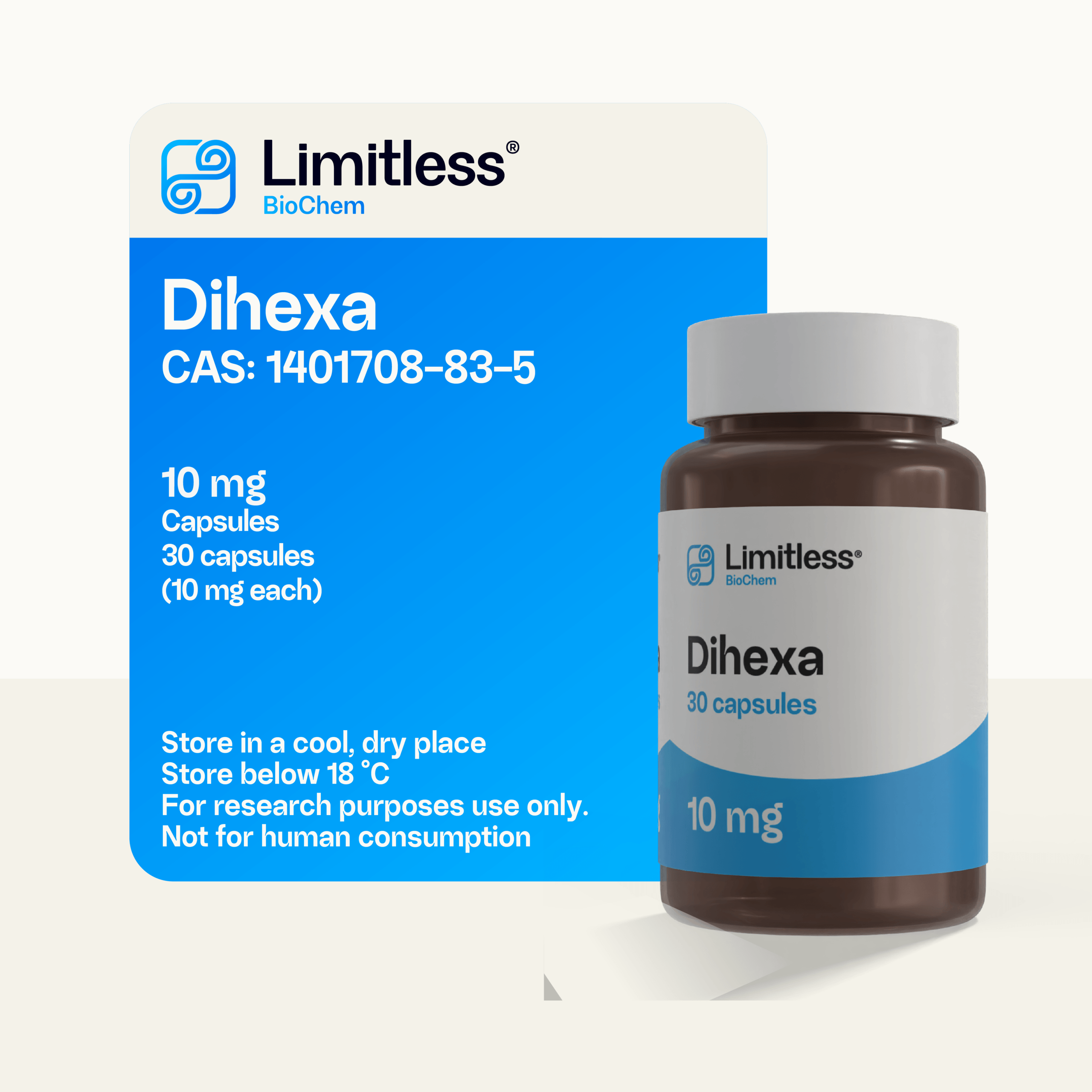
Dihexa 10 mg – 30 capsules
128.00€
Availability: 12 in stock
- Third Party Tested
- 14-Day Money Back Guarantee
- Fast Delivery Worldwide
Laboratory test for this product
View the certificate of analysis and laboratory verification for this product.
Dihexa 10 mg — 30 research capsules. Dihexa (N-hexanoic-Tyr-Ile-(6) aminohexanoic amide) is among the most strikingly potent synaptogenic molecules ever characterized in academic neuropharmacology. Developed in the laboratory of Joseph Harding at Washington State University as part of a program optimizing angiotensin-IV-derived neurotrophic peptides, Dihexa was reported to be approximately seven orders of magnitude (~10,000,000-fold) more potent than BDNF in inducing functional synaptogenesis between hippocampal neurons in vitro [1] — a headline figure that rests on a small number of papers from the originating laboratory, two of which have since been flagged by the publishing journal (see References). Its proposed primary mechanism is augmentation of hepatocyte growth factor / c-Met signaling, the same axis that drives neuronal repair after stroke and traumatic injury.
Research Overview
Dihexa is the most pharmacologically optimized member of the angiotensin-IV-derived neurotrophic peptide family — a research program initiated by the Harding group at Washington State University after the discovery that angiotensin IV itself enhances memory and synaptic plasticity in rodent models [1]. Successive structural modifications, principally to confer oral bioavailability and CNS penetration, produced Dihexa: an orally active, BBB-permeant peptidomimetic with no measurable angiotensin receptor activity but extraordinary synaptogenic potency [1,2]. In primary hippocampal neuron cultures, Dihexa was reported to induce formation of functional excitatory synapses at femtomolar concentrations, making it approximately seven orders of magnitude more potent than BDNF [1]. The proposed primary mechanism involves augmentation of hepatocyte growth factor (HGF) / c-Met receptor signaling, with downstream activation of MAPK, PI3K-Akt and the canonical synaptic-protein-synthesis machinery [2]. In aged rats with established scopolamine-induced or natural age-related memory deficits, oral Dihexa rescues spatial-memory performance to young-adult levels [3]. The compound has emerged as a flagship research tool in the synaptogenesis-driven approach to neurodegenerative disease.
Primary Research Areas
- Synaptogenesis pharmacology — approximately seven orders of magnitude more potent than BDNF in inducing functional synapse formation in hippocampal neuron cultures [1].
- HGF / c-Met receptor signaling — the principal proposed mechanism, providing a clean pharmacological probe of HGF-mediated neuronal repair pathways [2].
- Cognitive rescue in aged rodent models — restores spatial memory in aged rats and in scopolamine-induced cognitive deficit models at orally administered doses in those studies [3].
- Alzheimer’s and age-related cognitive decline research — investigated as a synaptogenesis-based alternative to amyloid-clearance and AChE-inhibitor strategies [1,3].
- Stroke and TBI repair models — of interest in research on post-injury synaptic remodeling and functional recovery [2].
References
- McCoy AT, Benoist CC, Wright JW, et al. Evaluation of metabolically stabilized angiotensin IV analogs as procognitive/antidementia agents. J Pharmacol Exp Ther. 2013;344(1):141–154.
- Benoist CC, Wright JW, Zhu M, et al. Facilitation of hippocampal synaptogenesis and spatial memory by C-terminal truncated Nle1-angiotensin IV analogs. J Pharmacol Exp Ther. 2011;339(1):35–44.
- Wright JW, Kawas LH, Harding JW. The development of small molecule angiotensin IV analogs to treat Alzheimer’s and Parkinson’s diseases. Prog Neurobiol. 2015;125:26–46.
Note on the evidence base: reference [1] carries a 2021 editorial Notice of Concern from the publishing journal, and a related 2014 paper from the same laboratory proposing the HGF/c-Met mechanism (J Pharmacol Exp Ther. 2014;351(2):390–402) was retracted in 2025. Independent work supports the core cognitive findings through separate approaches (Sun X, et al. Brain Sci. 2021;11(11):1487).
Find out what benefits peptides have
Discover how peptides can boost recovery, improve skin health, increase energy and support overall performance. Explained simply and clearly in this short video.
Why Limitless Biochem?
Limitless BioChem is a trusted supplier of research compounds. Our products meet strict quality standards and are compliant with EU requirements. We focus on the safe and reliable supply of peptides and pure compounds intended exclusively for research or collector purposes.
- Peptides, Nootropics, Amino acids...
- Products tested by an independent laboratory
- Exclusively pure compounds without additives
- Worldwide Delivery
- Warning
This product is not intended for human or veterinary use. It is for collection or research purposes only. It cannot be used as food, dietary supplement or medicine! The information provided in the text on this page is for educational purposes only and does not constitute medical or other advice.