- 15 000+ Verified Orders!
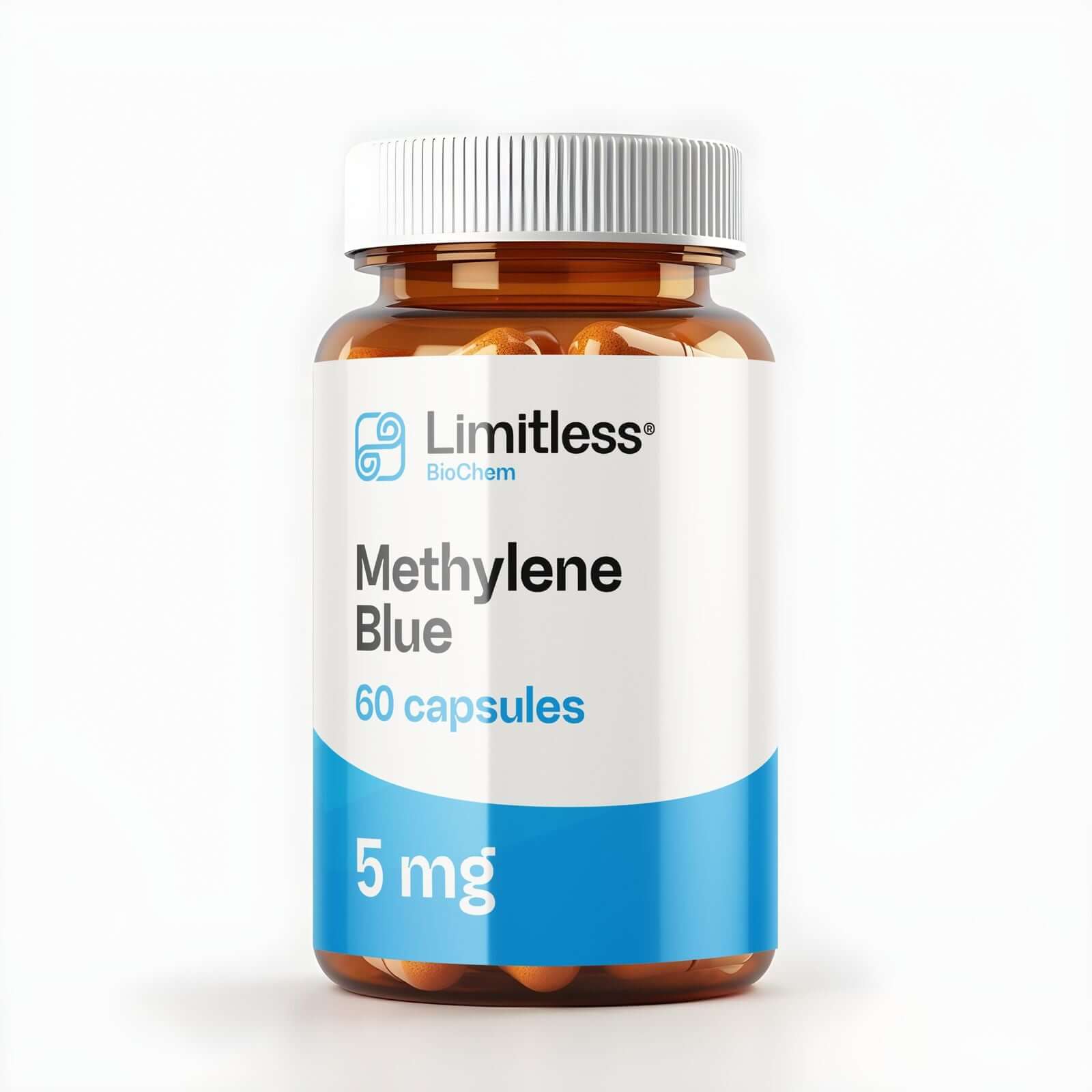
Methylene Blue 5 mg – 60 capsules
64.20€
Availability: 93 in stock
- Third Party Tested
- 14-Day Money Back Guarantee
- Fast Delivery Worldwide
Laboratory test for this product
View the certificate of analysis and laboratory verification for this product.
Methylene Blue 5 mg — 60 pharmaceutical-grade research capsules. Methylene blue holds a unique position in the history of pharmacology: it was the first synthetic drug ever used in humans (Ehrlich, 1891), the founding lead compound of every phenothiazine antipsychotic, the parent scaffold of every methylene-bridged tau aggregation inhibitor, and the gold-standard antidote for methemoglobinemia. In neuroscience, it has emerged over the past two decades as the most extensively characterized low-dose mitochondrial enhancer, with controlled human imaging studies demonstrating measurable effects on brain glucose metabolism, BOLD response and functional memory at doses an order of magnitude below the antimethemoglobinemia range. The 5 mg per-capsule format corresponds precisely to the low-dose nootropic and mitochondrial-enhancement window characterized in published clinical pharmacology.
Research Overview
Methylene blue (methylthioninium chloride) is a phenothiazine dye with an extraordinary range of well-characterized pharmacology, dose-dependent and frequently U-shaped [1]. At low concentrations (≤ 1 mg/kg), it acts as an alternative electron carrier in the mitochondrial electron transport chain — accepting electrons from NADH and donating them directly to cytochrome c — bypassing complex I/III blockades and increasing cellular ATP production and oxygen consumption rate [1,2]. At slightly higher concentrations it inhibits monoamine oxidase and tau aggregation, and at clinical-antidote concentrations it reduces methemoglobin to hemoglobin via the NADPH-dependent diaphorase pathway. Functional human imaging at 0.5–4 mg/kg shows increased cerebral glucose metabolism, BOLD response in memory-related circuits, and improved performance on declarative-memory tasks [3]. The molecule has a > 130-year clinical safety history, with the principal contraindications well-mapped (G6PD deficiency; concurrent serotonergic agents).
Primary Research Areas
- Mitochondrial bioenergetics and electron-transport bypass — the canonical small molecule for studying alternative-electron-carrier pharmacology and rescue of complex-I-deficient phenotypes [1,2].
- Cognitive and memory research — controlled human fMRI/PET studies show enhanced memory-task performance and increased brain glucose metabolism at low-dose ranges [3].
- Tauopathy and neurodegeneration — the parent scaffold for hydromethylthionine and a workhorse tool in tau-aggregation assays; investigated in AD, FTD and PSP models [1].
- Mood and psychiatric research — studied in bipolar depression and major depressive disorder, leveraging dose-dependent MAO-A inhibition and mitochondrial enhancement [1].
- Methemoglobinemia and oxidative-redox research — the gold-standard antidote and a robust probe of NADPH-diaphorase activity, G6PD-deficiency phenotypes and free-radical biology [1].
References
- Tucker D, Lu Y, Zhang Q. From mitochondrial function to neuroprotection — an emerging role for methylene blue. Mol Neurobiol. 2018;55(6):5137–5153.
- Atamna H, Nguyen A, Schultz C, et al. Methylene blue delays cellular senescence and enhances key mitochondrial biochemical pathways. FASEB J. 2008;22(3):703–712.
- Rodriguez P, Zhou W, Barrett DW, et al. Multimodal randomized functional MR imaging of the effects of methylene blue in the human brain. Radiology. 2016;281(2):516–526.
Find out what benefits peptides have
Discover how peptides can boost recovery, improve skin health, increase energy and support overall performance. Explained simply and clearly in this short video.
Why Limitless Biochem?
Limitless BioChem is a trusted supplier of research compounds. Our products meet strict quality standards and are compliant with EU requirements. We focus on the safe and reliable supply of peptides and pure compounds intended exclusively for research or collector purposes.
- Peptides, Nootropics, Amino acids...
- Products tested by an independent laboratory
- Exclusively pure compounds without additives
- Worldwide Delivery
- Warning
This product is not intended for human or veterinary use. It is for collection or research purposes only. It cannot be used as food, dietary supplement or medicine! The information provided in the text on this page is for educational purposes only and does not constitute medical or other advice.