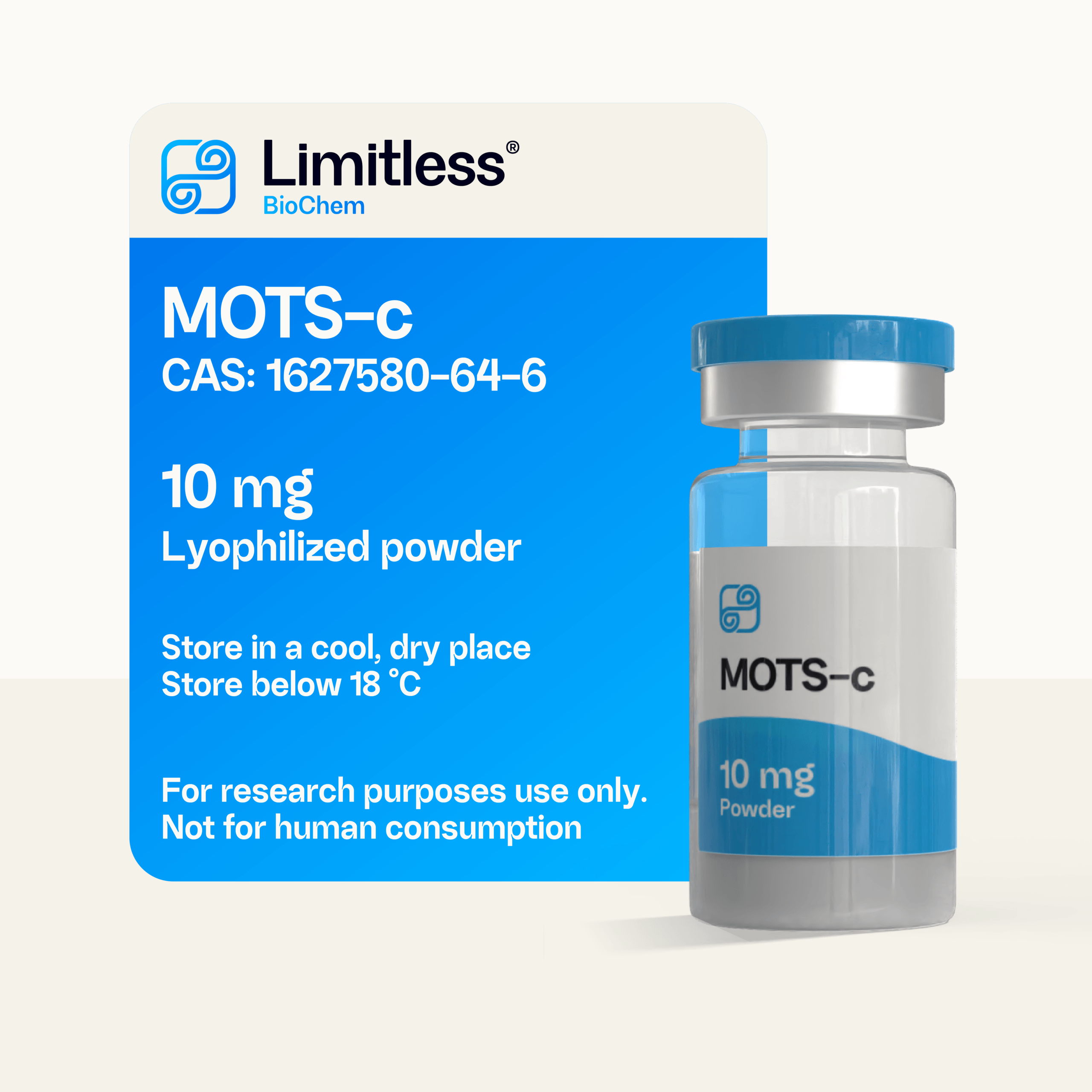
MOTS-c 10 mg research-grade lyophilized peptide powder in a glass vial. Mitochondria-derived peptide studied in metabolic regulation, AMPK signaling, mitochondrial function and cellular stress models.
Research Use Only: All products are intended exclusively for laboratory and scientific research. Not for human or veterinary use.
Research Overview
MOTS-c is a 16-amino-acid mitochondria-derived peptide encoded by the mitochondrial genome. In experimental models it is used to probe metabolic regulation, AMPK-related signaling, mitochondrial function and cellular stress responses.
Primary Research Areas
- Metabolic regulation & AMPK: models examining glucose uptake, insulin sensitivity and AMPK-dependent pathways [6].
- Mitochondrial function & bioenergetics: studies focused on mitochondrial health, biogenesis and cellular energy homeostasis [2].
- Cellular stress & oxidative balance: experiments on oxidative stress, cytoprotection and stress-response signaling [5].
- Exercise-mimetic & aging research: preclinical work exploring exercise-like adaptations and age-related metabolic decline [7,8].
- Bone loss: mice whose ovaries were removed lost bone, and 5 mg/kg of MOTS-c injected once a day for 12 weeks clearly slowed that loss on micro-CT scanning, largely by blocking the formation of bone-resorbing cells. This is an osteoporosis model in mice at a high daily dose [1].
- Fatty liver disease: in mice fed a diet that produces non-alcoholic steatohepatitis, MOTS-c given either from the start or only once the disease was established reduced liver fat, cell death, inflammation and scarring, and restored the liver’s mitochondrial capacity. Mice only, and the benefit depended on the peptide stabilising one specific protein (Bcl-2) [2].
- Type 1 diabetes: in NOD mice, which destroy their own insulin-producing cells, MOTS-c slowed the rise in blood sugar and cut the number of immune cells invading the islets. People with type 1 diabetes were also found to have lower blood MOTS-c than healthy controls, which is an association and not proof of cause [3].
- How blood vessels respond: among 40 patients having angiography for angina without narrowed arteries, the 20 whose vessels responded poorly to acetylcholine had lower blood MOTS-c than the other 20. In rat and mouse vessel rings the peptide did not widen them but improved their response to acetylcholine. The human half is a correlation in a small group [4].
- Newborn hearts given too much oxygen: newborn mice kept in 85% oxygen developed thickened, scarred, poorly functioning hearts while their blood MOTS-c fell, and giving MOTS-c reversed much of that damage. This speaks to babies on oxygen support rather than to adults, and it was done only in mice and a rat heart-cell line [5].
References
- Ming W, Lu G, Xin S, et al. Mitochondria related peptide MOTS-c suppresses ovariectomy-induced bone loss via AMPK activation. Biochem Biophys Res Commun. 2016;476(4):412-419. PMID 27237975. doi:10.1016/j.bbrc.2016.05.135
- Lu H, Fan L, Zhang W, et al. The mitochondrial genome-encoded peptide MOTS-c interacts with Bcl-2 to alleviate nonalcoholic steatohepatitis progression. Cell Rep. 2024;43(1):113587. PMID 38206815. doi:10.1016/j.celrep.2023.113587
- Kong BS, Min SH, Lee C, et al. Mitochondrial-encoded MOTS-c prevents pancreatic islet destruction in autoimmune diabetes. Cell Rep. 2021;36(4):109447. PMID 34320351. doi:10.1016/j.celrep.2021.109447
- Qin Q, Delrio S, Wan J, et al. Downregulation of circulating MOTS-c levels in patients with coronary endothelial dysfunction. Int J Cardiol. 2018;254:23-27. PMID 29242099. doi:10.1016/j.ijcard.2017.12.001
- Li SH, Chen SQ, Lu T, et al. MOTS-c attenuates hyperoxia-induced neonatal cardiac injury by inhibiting oxeiptosis via maintaining the KEAP1-PGAM5 interaction. Life Sci. 2026;398:124452. PMID 42128272. doi:10.1016/j.lfs.2026.124452
- Lee C, Zeng J, Drew BG, et al. The mitochondrial-derived peptide MOTS-c promotes metabolic homeostasis and reduces obesity and insulin resistance. Cell Metab. 2015;21(3):443-54. PMID 25738459. doi:10.1016/j.cmet.2015.02.009
- Reynolds JC, Lai RW, Woodhead JST, et al. MOTS-c is an exercise-induced mitochondrial-encoded regulator of age-dependent physical decline and muscle homeostasis. Nat Commun. 2021;12(1):470. PMID 33473109. doi:10.1038/s41467-020-20790-0
- Ramanjaneya M, Jerobin J, Bettahi I, et al. Lipids and insulin regulate mitochondrial-derived peptide (MOTS-c) in PCOS and healthy subjects. Clin Endocrinol (Oxf). 2019;91(2):278-287. PMID 31066084. doi:10.1111/cen.14007
Reconstitution
Recommended solvent — Bacteriostatic water

For diluting lyophilized peptide powders, use a sterile and suitable research solvent such as bacteriostatic water (BAC), which may help support handling stability and reduce contamination risk.
For convenient laboratory use, see Bacteriostatic Water – 10 ml.