- 15 000+ Verified Orders!
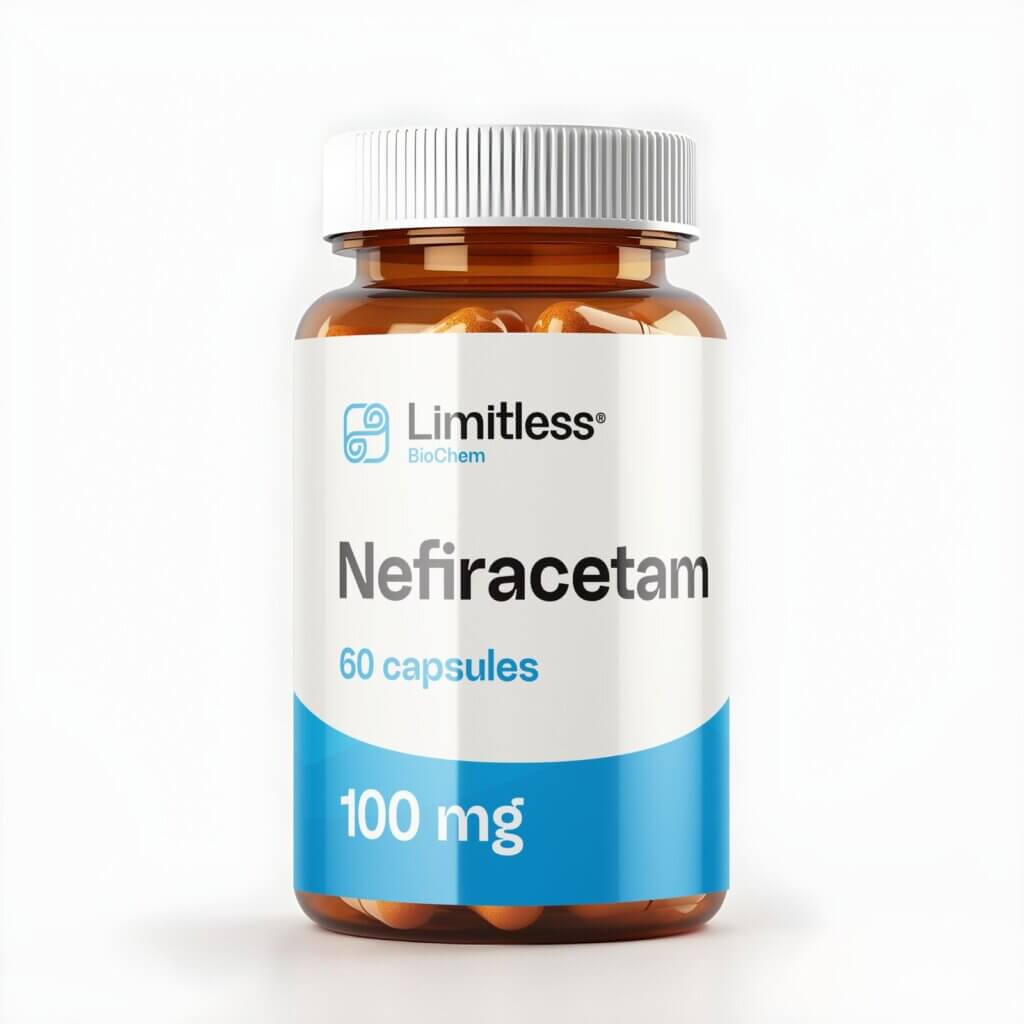
Nefiracetam 100 mg – 60 capsules (preorder)
40.99€
- Third Party Tested
- 14-Day Money Back Guarantee
- Fast Delivery Worldwide
Laboratory test for this product
View the certificate of analysis and laboratory verification for this product.
Nefiracetam 100 mg — 60 oral research capsules. Nefiracetam (DM-9384) is one of the most clinically advanced members of the entire racetam class — the subject of multi-thousand-patient Phase II/III trials in post-stroke depression, post-stroke apathy and Alzheimer’s disease at Daiichi Pharmaceutical in Japan. Mechanistically, Nefiracetam pairs the canonical racetam cholinergic and glutamatergic profile with two distinctive additional activities: GABA-A positive modulation that produces an anxiolytic phenotype not seen in piracetam or aniracetam, and direct enhancement of L-type voltage-gated calcium channel activity — a mechanism uniquely positioned to influence post-ischemic synaptic plasticity. The 100 mg per-capsule dose corresponds to the principal Phase II/III dose tier explored in the Japanese clinical-research program.
Research Overview
Nefiracetam (DM-9384) is a 2-pyrrolidinone-derivative nootropic developed by Daiichi Pharmaceutical in Japan in the 1980s, and the only racetam to have advanced through multiple large-scale Phase II/III clinical programs in Western-style indications [1]. In Phase II trials in post-stroke depression and post-stroke apathy, Nefiracetam produced significant separation from placebo on Hamilton Depression and apathy-scale endpoints — the latter being a particularly notable result because no approved drug specifically targets post-stroke apathy [1,2]. Mechanistically, Nefiracetam combines the canonical racetam pro-cholinergic profile (enhancement of high-affinity choline uptake and acetylcholine release) and pro-glutamatergic profile (NMDA-receptor potentiation in a glycine-site-independent manner) with two distinctive additional mechanisms: positive allosteric modulation of GABA-A receptors (the basis of an anxiolytic phenotype absent in earlier racetams) and direct enhancement of L-type voltage-gated calcium-channel activity in hippocampal pyramidal neurons [2,3]. This calcium-channel activity is unique within the racetam class and provides a distinctive mechanistic angle for studying post-ischemic synaptic plasticity. The molecule retains the benign safety profile typical of the racetam class across multi-thousand patient-years of clinical exposure.
Primary Research Areas
- Post-stroke depression and apathy research — the only racetam with Phase II/III RCT evidence in these indications, and one of the few molecules in any class with a documented signal on post-stroke apathy [5].
- Cholinergic and glutamatergic pharmacology — enhancement of high-affinity choline uptake, ACh release and NMDA-receptor potentiation — the canonical racetam profile [1].
- GABA-A positive allosteric modulation — the anxiolytic phenotype distinguishes Nefiracetam from earlier racetams (piracetam, aniracetam) [6].
- L-type voltage-gated calcium channel pharmacology — the unique calcium-channel mechanism within the racetam class, with post-ischemic synaptic-plasticity research applications [7].
- Alzheimer’s disease research — advanced through Phase II in AD; a useful comparator molecule against newer cognitive-enhancement chemotypes [8].
- Nerve pain — in mice with a partly tied-off sciatic nerve, and in mice made diabetic with streptozotocin, nefiracetam by mouth reversed both the heat and the pressure pain sensitivity while doing nothing to normal mice. The effect survived naloxone but was blocked by a nicotinic blocker, so it is not working like an opioid. Mice only [1].
- Memory after a stroke — rats given a stroke by injecting 700 microspheres into one brain artery learned a water maze badly; 10 mg/kg of nefiracetam by mouth, started the day after, shortened their escape times. A companion study in the same model found no shrinkage of the damaged area, so this is function recovering rather than tissue saved [2].
- Seizures in rats — nefiracetam injected into rats during kainic-acid-induced limbic seizures stopped the seizures at doses above 100 mg/kg and limited how far the seizure activity spread through the brain. The animals were sedated at those doses, and 100 mg/kg in a rat is far above anything a person would swallow [3].
- Rett syndrome nerve cells — human stem-cell-derived neurons and cortical organoids with the MECP2 gene knocked out, the cause of Rett syndrome, show faulty synapses and disordered network activity, and of the compounds screened nefiracetam was one of only two that specifically reversed that damage. These are human cells in a dish rather than a person [4].
References
- Rashid MH, Ueda H. Nonopioid and neuropathy-specific analgesic action of the nootropic drug nefiracetam in mice. J Pharmacol Exp Ther. 2002;303(1):226-31. PMID 12235255. doi:10.1124/jpet.102.037952
- Takeo S, Fukatsu T, Miyake-Takagi K, et al. Persistent effects of delayed treatment with nefiracetam on the water maze task in rats with sustained cerebral ischemia. J Pharmacol Exp Ther. 2003;304(2):513-23. PMID 12538802. doi:10.1124/jpet.102.043653
- Hashizume K, Kunimoto M, Maeda T, et al. Antiepileptic effect of nefiracetam on kainic acid-induced limbic seizure in rats. Epilepsy Res. 2000;39(3):221-8. PMID 10771248. doi:10.1016/s0920-1211(00)00099-1
- Trujillo CA, Adams JW, Negraes PD, et al. Pharmacological reversal of synaptic and network pathology in human MECP2-KO neurons and cortical organoids. EMBO Mol Med. 2021;13(1):e12523. PMID 33501759. doi:10.15252/emmm.202012523
- Robinson RG, Jorge RE, Clarence-Smith K, et al. Double-blind treatment of apathy in patients with poststroke depression using nefiracetam. J Neuropsychiatry Clin Neurosci. 2009;21(2):144-51. PMID 19622685. doi:10.1176/jnp.2009.21.2.144
- Huang CS, Ma JY, Marszalec W, et al. Effects of the nootropic drug nefiracetam on the GABAA receptor-channel complex in dorsal root ganglion neurons. Neuropharmacology. 1996;35(9-10):1251-61. PMID 9014140. doi:10.1016/s0028-3908(96)00074-3
- Yoshii M, Watabe S. Enhancement of neuronal calcium channel currents by the nootropic agent, nefiracetam (DM-9384), in NG108-15 cells. Brain Res. 1994;642(1-2):123-31. PMID 8032872. doi:10.1016/0006-8993(94)90913-x
- Pak J, Green J, Heifets B, et al. Nefiracetam ameliorates associative learning impairment in the scopolamine-injected older rabbit. Med Sci Monit. 2002;8(4):BR105-12. PMID 11951055.
Find out what benefits peptides have
Discover how peptides can boost recovery, improve skin health, increase energy and support overall performance. Explained simply and clearly in this short video.
Why Limitless Biochem?
Limitless BioChem is a trusted supplier of research compounds. Our products meet strict quality standards and are compliant with EU requirements. We focus on the safe and reliable supply of peptides and pure compounds intended exclusively for research or collector purposes.
- Peptides, Nootropics, Amino acids...
- Products tested by an independent laboratory
- Exclusively pure compounds without additives
- Worldwide Delivery
- Warning
This product is not intended for human or veterinary use. It is for collection or research purposes only. It cannot be used as food, dietary supplement or medicine! The information provided in the text on this page is for educational purposes only and does not constitute medical or other advice.