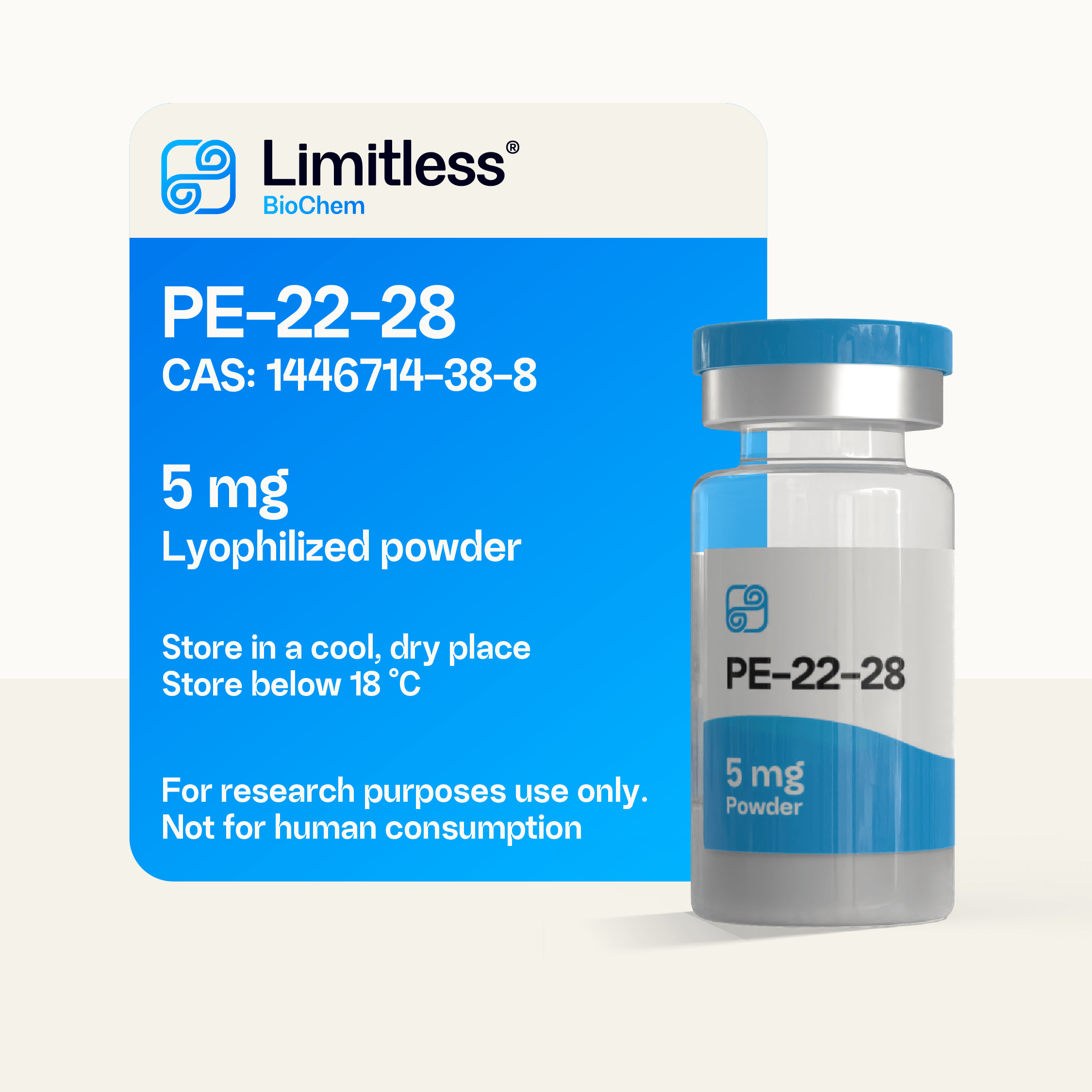
PE-22-28 5 mg research-grade lyophilized peptide powder in a glass vial. PE-22-28 is a synthetic heptapeptide (Gly-Val-Ser-Trp-Gly-Leu-Arg), a shortened analogue of spadin, itself derived from the sortilin propeptide (PE). It is studied as a TREK-1 (K2P2.1) potassium-channel blocker in neuroplasticity and mood-related research models.
Research Overview
PE-22-28 is a short neuroactive heptapeptide derived from spadin, itself a fragment of the sortilin propeptide (PE). In experimental neuroscience models it is used to block the TREK-1 potassium channel and to follow the downstream BDNF/TrkB signalling, hippocampal neurogenesis and neuronal-survival pathways in vitro and in vivo, without implying any therapeutic application.
Primary Research Areas
- TREK-1 channel & BDNF/TrkB signalling: Experimental models using PE-22-28 as a TREK-1 blocker to probe the downstream BDNF-related signalling cascades and kinase activation [1,2].
- Neurogenesis & synaptic plasticity: In vitro and in vivo studies examining hippocampal neurogenesis, synaptic density markers and plasticity-associated proteins under PE-22-28 exposure [1,2].
- Mood & stress-related models: Laboratory models of depression, anxiety and stress resilience evaluating how TREK-1 / TrkB pathway modulation influences behavioural and molecular readouts [1,3].
- Insulin release and blood sugar: the channel this peptide blocks also sits on the insulin-releasing cells of the pancreas. Blocking it with spadin made mouse islets and a beta-cell line put out more insulin, and in live mice raised the insulin rise after glucose. The finding concerns insulin release and glucose handling [4].
- Insulin cells surviving inflammation: cultured beta cells were protected from being killed by the inflammatory signal interleukin-1-beta by the parent propeptide and its short derivatives, mini-spadin included, and mini-spadin also made them multiply. Cell work only, with nothing tested in people with diabetes [5].
- Recovery after a stroke: mice given a stroke and then mini-spadin held their body weight, lost fewer dopamine neurons, moved and remembered better, and avoided the depression that usually follows. Dose direction mattered: 0.03 micrograms per kilo opened the channel, 3 micrograms per kilo blocked it [6].
- What blocking the channel might cost: mice without TREK-1 are more sensitive to pain, seizures and stroke damage, so blocking it is a fair worry. Tested against all three, spadin did none of that, and left heart rhythm, blood pressure and blood sugar alone. That was spadin, not the shorter peptide sold here [7].
- Divers and decompression: mice put through a five-day course of spadin before a simulated dive were more likely to get decompression sickness than untreated mice, though fluoxetine given on top protected them again. It is one mouse experiment, and the effect went in the unfavourable direction [8].
References
- Djillani A, Pietri M, Moreno S, et al. Shortened Spadin Analogs Display Better TREK-1 Inhibition,Stability and Antidepressant Activity. Front Pharmacol. 2017;8:643. PMID 28955242. doi:10.3389/fphar.2017.00643
- Devader C, Khayachi A, Veyssière J, et al. In vitro and in vivo regulation of synaptogenesis by the novel antidepressant spadin. Br J Pharmacol. 2015;172(10):2604-17. PMID 25598009. doi:10.1111/bph.13083
- Qi X, Xu H, Wang L, et al. Comparison of Therapeutic Effects of TREK1 Blockers and Fluoxetine on Chronic Unpredicted Mild Stress Sensitive Rats. ACS Chem Neurosci. 2018;9(11):2824-2831. PMID 29952548. doi:10.1021/acschemneuro.8b00225
- Hivelin C, Béraud-Dufour S, Devader C, et al. Potentiation of Calcium Influx and Insulin Secretion in Pancreatic Beta Cell by the Specific TREK-1 Blocker Spadin. J Diabetes Res. 2016;2016:3142175. PMID 28105440. doi:10.1155/2016/3142175
- Daziano G, Blondeau N, Béraud-Dufour S, et al. Sortilin-derived peptides promote pancreatic beta-cell survival through CREB signaling pathway. Pharmacol Res. 2021;167:105539. PMID 33737242. doi:10.1016/j.phrs.2021.105539
- Pietri M, Djillani A, Mazella J, et al. First evidence of protective effects on stroke recovery and post-stroke depression induced by sortilin-derived peptides. Neuropharmacology. 2019;158:107715. PMID 31325429. doi:10.1016/j.neuropharm.2019.107715
- Moha Ou Maati H, Veyssiere J, Labbal F, et al. Spadin as a new antidepressant: absence of TREK-1-related side effects. Neuropharmacology. 2012;62(1):278-88. PMID 21807005. doi:10.1016/j.neuropharm.2011.07.019
- Vallée N, Lambrechts K, De Maistre S, et al. Fluoxetine Protection in Decompression Sickness in Mice is Enhanced by Blocking TREK-1 Potassium Channel with the “spadin” Antidepressant. Front Physiol. 2016;7:42. PMID 26909044. doi:10.3389/fphys.2016.00042
Recommended solvent — Bacteriostatic water

For diluting lyophilized peptide powders, use a sterile and suitable research solvent such as bacteriostatic water (BAC), which may help support handling stability and reduce contamination risk.
For convenient laboratory use, see Bacteriostatic Water – 10 ml.