- 15 000+ Verified Orders!
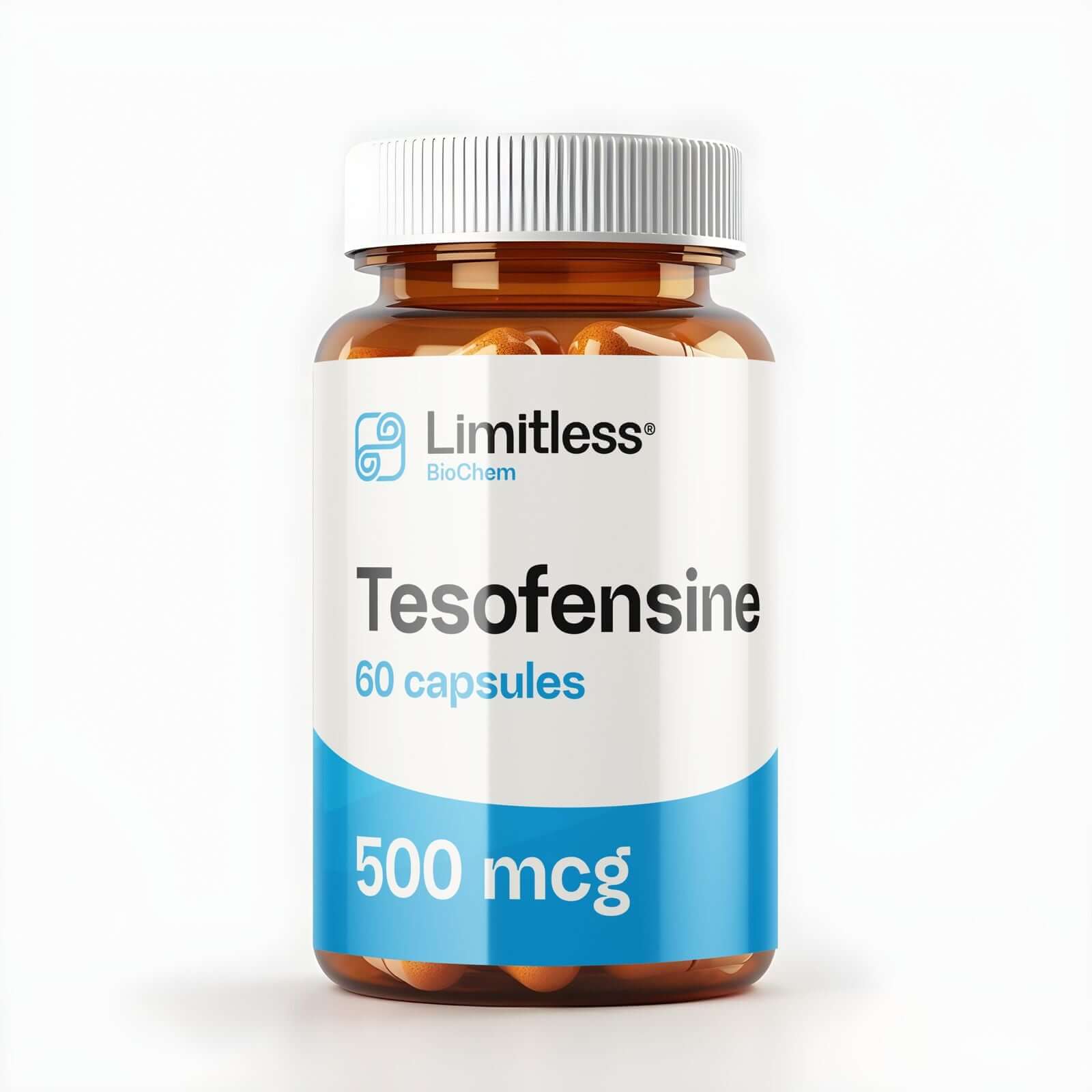
Tesofensine 500 mcg – 60 capsules
149.80€
Availability: 175 in stock
- Third Party Tested
- 14-Day Money Back Guarantee
- Fast Delivery Worldwide
Laboratory test for this product
View the certificate of analysis and laboratory verification for this product.
Tesofensine 500 mcg — 60 research capsules. Tesofensine is a triple monoamine reuptake inhibitor (serotonin / noradrenaline / dopamine) originally developed for Parkinson’s and Alzheimer’s disease, where it failed efficacy endpoints — but unexpectedly produced the largest weight-loss signal ever recorded in a Phase II obesity trial. In a 24-week placebo-controlled study, 1.0 mg daily produced 12.8 kg of weight loss versus 2.2 kg on placebo: roughly twice the magnitude observed with sibutramine, and approaching the range now seen with tirzepatide and retatrutide despite a fundamentally different mechanism. The molecule has since advanced through Phase III in hypothalamic obesity. The 500 mcg per-capsule potency corresponds to the lower clinical-pharmacology dose tier.
Research Overview
Tesofensine is a tropane derivative that inhibits the dopamine, serotonin and noradrenaline transporters with relatively balanced affinity — distinguishing it from the predominantly serotonergic profiles of older anti-obesity SNRIs [1]. The compound was originally developed by NeuroSearch as a treatment for Parkinson’s and Alzheimer’s disease; it failed primary efficacy endpoints in those indications but unexpectedly produced sustained weight loss in nearly every cohort tested. The pivotal Phase II TIPO-1 trial reported mean weight loss of 4.5 %, 9.2 % and 10.6 % at 0.25, 0.5 and 1.0 mg respectively, versus 2.0 % with diet and placebo, over 24 weeks, with appetite reduction and reductions in hunger ratings as the proximate mechanism — the magnitude approaches modern incretin therapies despite operating through an entirely different pathway [1,2]. The molecule has subsequently been combined with metoprolol (Tesomet) to mitigate cardiovascular signal, and has advanced through Phase III in hypothalamic obesity and Prader–Willi syndrome [2,3]. In experimental research, tesofensine is widely used as a clean tool to dissect appetite-suppressing versus reward-modulating effects of triple-monoamine pharmacology.
Primary Research Areas
- Appetite and food-reward research — preclinical and human evidence of central appetite suppression independent of GLP-1/GIP/leptin pathways, with reduction in hedonic food choice [4].
- Triple-monoamine reuptake-inhibitor pharmacology — the leading clinical-stage probe of balanced dopamine/noradrenaline/serotonin reuptake inhibition outside the antidepressant ATC class [1,8].
- Obesity and metabolic-syndrome models — Phase II and III evidence of double-digit weight loss; investigated for hypothalamic obesity, Prader–Willi, and rare genetic obesity syndromes [1,2,3].
- Reward, motivation and addiction research — dopaminergic enhancement makes it a useful probe of reward-circuit pharmacology and a comparator molecule in stimulant and food-addiction paradigms [8].
- Neurological / Parkinson’s disease research — the original development indication; preclinical models continue to use tesofensine as a balanced triple-monoamine reuptake tool [7].
- Heart rate climbs — in a 24-week trial of 203 obese adults, the 0.5 mg group’s heart rate rose 7.4 beats a minute, and across 968 Parkinson’s and Alzheimer’s patients the rise reached 6.8 bpm at 1 mg. Blood pressure did not rise at these doses; the developer later paired the drug with a beta-blocker [1,2,3].
- Dry mouth, constipation, poor sleep — across the obesity trials the usual complaints were dry mouth, nausea, constipation, hard stools, diarrhoea and insomnia. In 21 adults given the tesofensine-metoprolol combination, sleep was disturbed in 50 per cent against 13 on placebo, and dry mouth affected 43 per cent against none [1,3].
- Mood and nerves — gut and neuropsychiatric side effects were commoner on tesofensine than placebo in advanced Parkinson’s patients, and grew commoner at higher doses. One adult in the hypothalamic-obesity trial had to stop because existing anxiety flared, so a history of anxiety is worth knowing about [3,7].
- Fat burned overnight — 32 overweight and moderately obese men took it for two weeks in a respiration-chamber study. Total 24-hour energy use did not change, but night-time energy use rose 4.6 per cent and the fat burned over 24 hours rose by 18 grams [4].
- Insulin beyond the weight loss — obese rats given 1.0 or 2.5 mg/kg by mouth for 28 days lost 5.7 and 9.9 per cent of body weight, mostly abdominal and under-skin fat. In a glucose test, only tesofensine pushed the insulin response below what matched food restriction achieved, so the sugar benefit is not only from eating less [5].
- Mouth and tongue movements — in rats filmed and scored automatically, tesofensine most often produced orolingual dyskinesia, meaning repetitive mouth and tongue movements, and caused head-weaving only in females, less than phentermine or amphetamine did. Female rats also lost more weight than males on the same dose [6].
References
- Astrup A, Madsbad S, Breum L, et al. Effect of tesofensine on bodyweight loss, body composition, and quality of life in obese patients: a randomised, double-blind, placebo-controlled trial. Lancet. 2008;372(9653):1906-1913. PMID 18950853. doi:10.1016/S0140-6736(08)61525-1
- Astrup A, Meier DH, Mikkelsen BO, et al. Weight loss produced by tesofensine in patients with Parkinson’s or Alzheimer’s disease. Obesity (Silver Spring). 2008;16(6):1363-9. PMID 18356831. doi:10.1038/oby.2008.56
- Huynh K, Klose M, Krogsgaard K, et al. Randomized controlled trial of Tesomet for weight loss in hypothalamic obesity. Eur J Endocrinol. 2022;186(6):687-700. PMID 35294397. doi:10.1530/EJE-21-0972
- Sjödin A, Gasteyger C, Nielsen AL, et al. The effect of the triple monoamine reuptake inhibitor tesofensine on energy metabolism and appetite in overweight and moderately obese men. Int J Obes (Lond). 2010;34(11):1634-43. PMID 20479765. doi:10.1038/ijo.2010.87
- Hansen HH, Hansen G, Tang-Christensen M, et al. The novel triple monoamine reuptake inhibitor tesofensine induces sustained weight loss and improves glycemic control in the diet-induced obese rat: comparison to sibutramine and rimonabant. Eur J Pharmacol. 2010;636(1-3):88-95. PMID 20385125. doi:10.1016/j.ejphar.2010.03.026
- Lopez A, Gil-Lievana E, Gutierrez R. Sex-specific effects of appetite suppressants on stereotypy in rats. PLoS One. 2025;20(6):e0325067. PMID 40554466. doi:10.1371/journal.pone.0325067
- Rascol O, Poewe W, Lees A, et al. Tesofensine (NS 2330), a monoamine reuptake inhibitor, in patients with advanced Parkinson disease and motor fluctuations: the ADVANS Study. Arch Neurol. 2008;65(5):577-83. PMID 18474731. doi:10.1001/archneur.65.5.577
- Schoedel KA, Meier D, Chakraborty B, et al. Subjective and objective effects of the novel triple reuptake inhibitor tesofensine in recreational stimulant users. Clin Pharmacol Ther. 2010;88(1):69-78. PMID 20520602. doi:10.1038/clpt.2010.67
Find out what benefits peptides have
Discover how peptides can boost recovery, improve skin health, increase energy and support overall performance. Explained simply and clearly in this short video.
Why Limitless Biochem?
Limitless BioChem is a trusted supplier of research compounds. Our products meet strict quality standards and are compliant with EU requirements. We focus on the safe and reliable supply of peptides and pure compounds intended exclusively for research or collector purposes.
- Peptides, Nootropics, Amino acids...
- Products tested by an independent laboratory
- Exclusively pure compounds without additives
- Worldwide Delivery
- Warning
This product is not intended for human or veterinary use. It is for collection or research purposes only. It cannot be used as food, dietary supplement or medicine! The information provided in the text on this page is for educational purposes only and does not constitute medical or other advice.